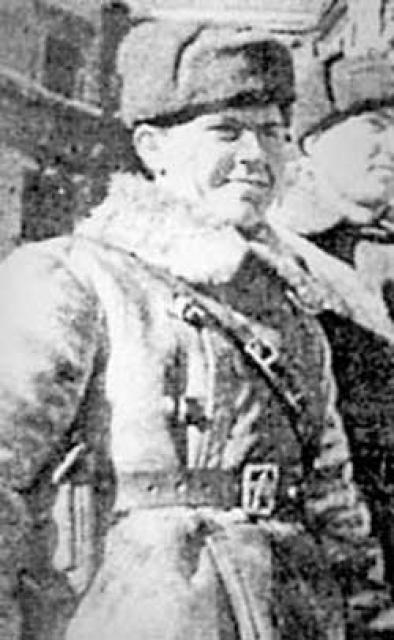
Fedor Ilchenko
 Ukraine
- Biography of Fedor Ilchenko
- The Summer of 1942
- Difficult Conditions
- Capturing Paulus
- Surrender and Aftermath
Biography of Fedor Ilchenko
Fedor Mikhailovich Ilchenko, a 22-year-old Russian officer, gained fame for capturing German Field Marshal Paulus as a prisoner of war. He recounts the events leading to the capture. Twelve years ago, an excerpt from Alexander Vert's book "Russia in War: 1941-1945" was published in the magazine "AIF," dedicated to the capitulation of Paulus' 6th army in Stalingrad. The author described how a young curly-haired lieutenant with a perpetual smile on his face, Fedor Mikhailovich Ilchenko, took the German Field Marshal as a prisoner. Since then, 62 years have passed, but we managed to find this curly old man, now an 83-year-old reserve colonel, living in Kiev.
The Summer of 1942
In the summer of 1942, Stalin began forming a powerful strike force to defeat the Germans in Stalingrad. Fedor Ilchenko was assigned to the 38th separate motorized rifle brigade; as a 22-year-old senior lieutenant, he was the sixth officer to join this reserve unit. The brigade, consisting of 6,500 soldiers, was hastily assembled in just 18 days and thrown into battle. After several days of fighting on Mamayev Kurgan, only 138 soldiers remained in the brigade. Replacements came directly from hospitals, with recovering soldiers going straight from their hospital beds to the trenches. Mostly, specialists from the rear who had "armor" and worked in the evacuation on the city's defense plants replaced the fallen soldiers.
Difficult Conditions
Fedor Ilchenko recalls the harsh conditions they faced during the battle. He recounts how they were well-equipped compared to other soldiers: each had cotton pants, a shirt, felt boots, and a fur coat. They were prepared for the harsh Russian winter. They were provided with ample food by front standards, including a hot soup once a day. However, due to the enemy artillery destroying their field kitchens, the meals were not always regular. Nevertheless, they always had a kilogram of bread per soldier and, of course, vodka. According to Ilchenko, alcohol was essential to survive the freezing temperatures, as they spent many nights in the open field on bare ground. He also mentions that lice infested both their own and the German soldiers' uniforms.
Capturing Paulus
The Germans had no chance of escaping the Stalingrad encirclement. Facing them were the Russians, whom the Nazis feared as prisoners, and behind them were the military police, shooting at deserters and impostors. The daily ration for German soldiers under Stalingrad consisted of a stale bread loaf for five people and a piece of horse meat. They resorted to eating cats, dogs, hedgehogs, crows, and rats. There were even cases of cannibalism, as the Nazis attempted to eat the bodies of their comrades. The high command of the 6th army was ready to abandon their soldiers to their fate. Special officer and general groups were formed to plan an escape from the "cauldron" on skis. However, when Paulus heard about this plan, he dismissed it. Contrary to German military intelligence claims, there was no special operation to capture Paulus. No one shouted, "Hände hoch!" (Hands up!) to him. Nobody intended to capture the Field Marshal because no one knew if he was in Stalingrad. However, rumors circulated among the Germans that a special NKVD unit was searching for Paulus to deliver him to the Kremlin as a gift for New Year's.
Ilchenko describes the capture of Paulus as a pure coincidence. He explains that during one of their operations, they captured a polyglot German officer who knew several languages, including Russian. Through him, they discovered the location of the German headquarters. Ilchenko, along with two other officers, managed to enter the basement, where Paulus was hiding. Ilchenko demanded that Paulus be brought to him, and the Field Marshal eventually emerged from his hiding place. Ilchenko escorted him to surrender to the Soviet army.
Surrender and Aftermath
Paulus refused to leave through the central entrance like all the other soldiers. Instead, he was led through a secret passage made by removing sandbags covering one of the windows. Ilchenko witnessed Paulus's exit into the daylight. After the initial interrogation, General Lieutenant Mikhail Shumilov, the commander of the 64th Army, invited Paulus and his subordinates to a guard of honor lunch, which included vodka. Paulus did not give any toasts but did not refuse to drink in honor of the courage of the Russian soldiers in Stalingrad.


