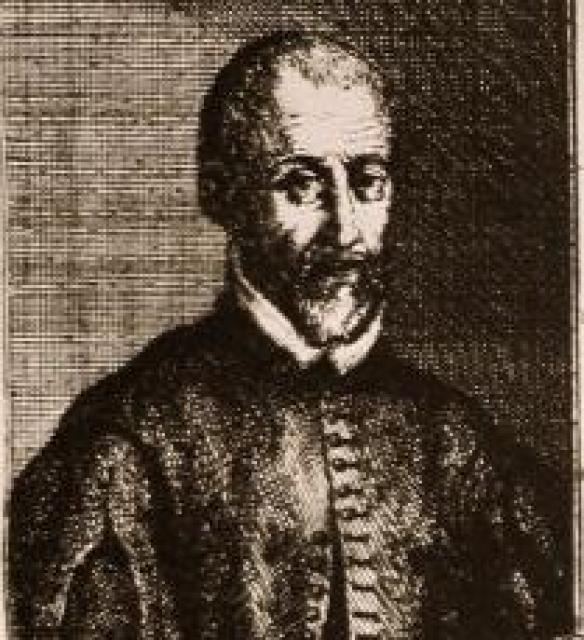
Felice Anerio
 Italy
Italy- Biography of Felice Anerio
- Early Life and Musical Career
- Professional Positions
- Appointment as Papal Composer
- Musical Style and Legacy
- Legacy and Death
Biography of Felice Anerio
Felice Anerio was an Italian composer of the late Renaissance and early Baroque period, and a member of the Roman School of composers. He was the elder brother of another significant composer of the same period, Giovanni Francesco Anerio. Felice Anerio was born in 1560 in Rome and spent his entire life in the city.
Early Life and Musical Career
As a child, Anerio sang as a soprano in the choir of the Basilica di San Pietro, known as the "Cappella Giulia," from 1568 to 1577. By this time, he had already become an alto. He then joined the choir of another church and continued singing until around 1580. During this time, Anerio began composing music, particularly madrigals. It was one of the few periods in his life when he wrote secular music. He was likely influenced by Luca Marenzio, a renowned madrigal composer who was exceptionally popular in Rome at that time.
Professional Positions
By 1584, Anerio was appointed as the maestro di cappella of the English College, where future Catholic priests trained for service in England. He also served as the choir director for the virtuoso musicians of Rome, known as the "Compagnia de i Musici di Roma." These positions provided Anerio with ample opportunities to fully realize his talents as a composer. By this time, he was writing not only madrigals but also songs, hymns, motets, and other choral works.
Appointment as Papal Composer
In 1594, Felice Anerio succeeded the renowned polyphonist Giovanni Pierluigi da Palestrina as the official composer of the papal choir. This was the highest position a composer in Rome could achieve. In 1607 or shortly thereafter, he became a priest, which was a common practice among composers of the Roman School. Alongside Francesco Soriano, another prominent representative of the Roman School, Anerio worked on reforming responsories, monodic chants used in Catholic worship. This was one of the final actions of the Counter-Reformation in Italy.
Musical Style and Legacy
Felice Anerio was a conservative composer who drew inspiration for his sacred music from the style of Palestrina, at least after he finished composing madrigals and canzonettas. However, he managed to achieve expressive brilliance and depth that were uniquely his own. Anerio's works show some influence from progressive composers from northern Italy, albeit subtly. For example, he utilized double choirs, a practice common in Venice, as well as fast homophonic declamatory textures and quick melodic passages in the bass line influenced by monody. He also enjoyed rapidly changing textures, alternating between full choirs and small groups of two or three voices, another progressive feature of northern Italian schools, seen in the music of Claudio Monteverdi, for example. Anerio's later works bear the imprint of compositions by the Franciscan composer Lodovico Viadana, known for popularizing the basso continuo, but Anerio remained true to the style of Palestrina. Anerio did not write instrumental music, or if he did, it has not survived.
Legacy and Death
Felice Anerio passed away on September 26 or 27, 1614. Many of his works were published in 1854 by the German priest Karl Proske.


