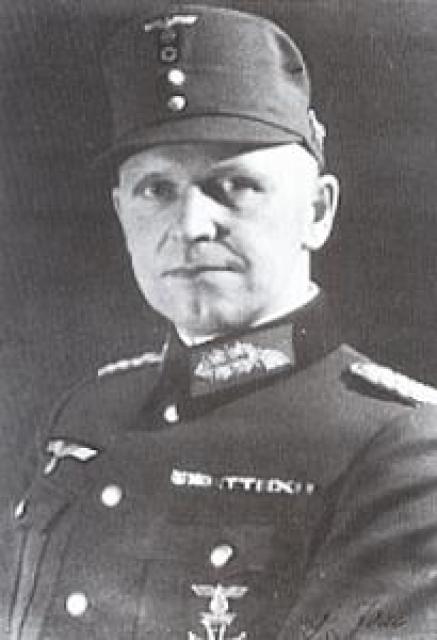
Ferdinand Jodl
 Germany
Biography of Ferdinand Jodl
Ferdinand Jodl, a German Wehrmacht officer, served as the General of the Mountain Troop Division of the Norwegian Mountain Corps during the Petsamo-Kirkenes Operation. He was the younger brother of Alfred Jodl. Ferdinand Jodl was born on November 23, 1896, and passed away on June 9, 1956.
Early Life and Military Career
On August 15, 1914, Ferdinand joined the 4th Bavarian Field Artillery Regiment as a Sergeant following the outbreak of World War I. He wore the officer's star on his collar as a Feldwebel, aspiring to become an officer. In October 1915, Jodl was awarded the Iron Cross Second Class, and in November, he was promoted to the rank of Lieutenant. In January 1918, Ferdinand became a battery commander and was awarded the Iron Cross First Class in June of the same year. During World War I, he participated in combat on the Western Front.
After the war, Jodl served in the army of the Weimar Republic. In 1919, he became the assistant chief of artillery in the "Freikorps" formed by one of the prominent figures of the Third Reich, Hermann Hirla. At the beginning of World War II, Ferdinand was a Lieutenant Colonel and the Chief of Operations of the Staff of the 12th Corps.
Role in World War II
After serving on the Western Front in 1939 and 1940 and holding the position of Chief of Staff of the 12th Corps during the occupation of France, Jodl was appointed as the Chief of Staff of the 49th Mountain Corps, responsible for the capture of Gibraltar. On November 1, 1940, Ferdinand was promoted to Colonel, but the Supreme High Command of the Army (OKH) rejected the plan to capture Gibraltar. In 1941, Jodl was sent on a military mission to Albania. From January 1942, he served as the Chief of Staff of the "Norway" Army, which was established on December 19, 1940, with the main objective of defending Norway. At that time, the army, later named "Lapland" and then becoming the 20th Mountain Army, was fighting in the Soviet Polar region.
Ferdinand earned the rank of Major General in February 1942 and was awarded the German Cross in Gold for bravery on the battlefield in April 1943. In September 1943, Jodl became a Lieutenant General, and in April 1944, he became the commander of the 19th Mountain Infantry Corps. By the beginning of September 1944, Ferdinand was a General of Mountain Troops. During the retreat from Northern Russia and Finland to Northern Norway, he successfully conducted the operation, surviving continuous attacks from Soviet forces. In November 1944, the 19th Mountain Infantry Corps was renamed the "Narvik" Army Group. In January 1945, Jodl was awarded the highest order of the Third Reich, the Knight's Cross.
Later Life and Death
On May 9, 1945, Ferdinand surrendered to the British and was released from captivity in 1947. He died at the age of 59 in Essen, West Germany, in 1956, after living there following his liberation.


