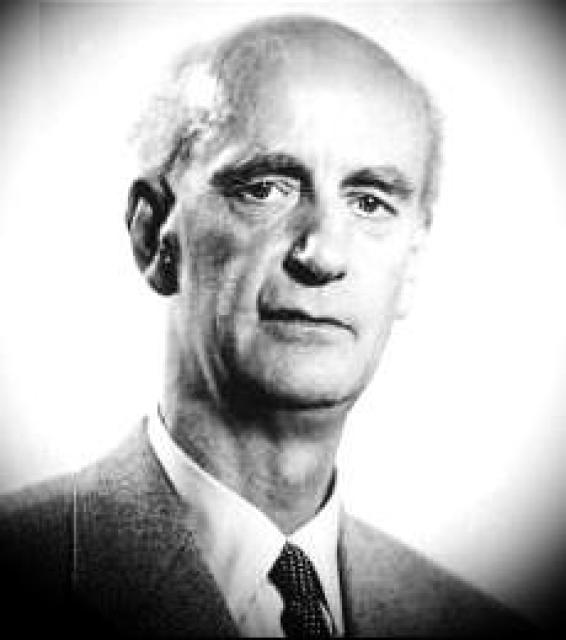
Paul Carell
 Germany
- Paul Schmidt: A Notorious Nazi Propagandist
- Early Life and Education
- Career in the SS
- Involvement in Holocaust Propaganda
- Post-World War II
- Investigation and Death
- Legacy
Paul Schmidt: A Notorious Nazi Propagandist
Paul Schmidt, a German military officer and SS-Obersturmbannführer, served as a leading press liaison in the Nazi Foreign Ministry under Joachim von Ribbentrop.
Early Life and Education
Born in 1899, Schmidt joined the Nazi Party in 1931. After graduating from university in 1934, he briefly worked as an assistant at the Institute of Psychology at the University of Kiel. He was also a member of the Nazi Student Association.
Career in the SS
In 1938, Schmidt joined the SS. By 1940, he had risen to the rank of SS-Obersturmbannführer and became the chief press officer for Ribbentrop. In this role, Schmidt managed the Foreign Ministry's press department and had extensive contact with journalists. His main responsibility was the daily press conference, making him a highly influential propagandist for Nazi Germany.
Involvement in Holocaust Propaganda
Recent research has confirmed that Schmidt was on par with Otto Dietrich and Hans Fritzsche in terms of influence. He also played a role in publishing "Signal," a Nazi propaganda magazine that reported on life in neutral and occupied countries during the war. Notably, Schmidt is known to have supported the Holocaust and devised a way to justify the deportation and murder of Hungarian Jews in 1944.
Post-World War II
Arrested in 1945 and held for 30 months, Schmidt's status remained uncertain until the Nuremberg Trials, where he testified as a witness against Nazi officials. He used this opportunity to portray himself as a defender of press freedom.
After the war, Schmidt became a writer under the pseudonym "Paul Carell," where he penned popular historical books in the 1950s for "Kristall."
Investigation and Death
From 1965 to 1971, German authorities investigated Schmidt's involvement in the murder of Hungarian Jews. However, the investigation did not conclusively establish his role. He never faced trial for his war crimes.
Despite the investigation, Schmidt continued his writing career. As Paul Carell, he became a popular author, aided by his numerous friends in the publishing industry.
Legacy
In 1992, Schmidt expressed his belief that Germany could have won the war even after the defeat at Stalingrad, attributing it to Hitler's blunders rather than the abilities of the Wehrmacht or commanders like Erich von Manstein. He also supported the controversial theory that Nazi Germany's invasion of the Soviet Union was a preemptive strike against an imminent Soviet attack.
Paul Schmidt-Carell died in 1997 at the age of 85, having escaped accountability for his actions as a Nazi propagandist.


