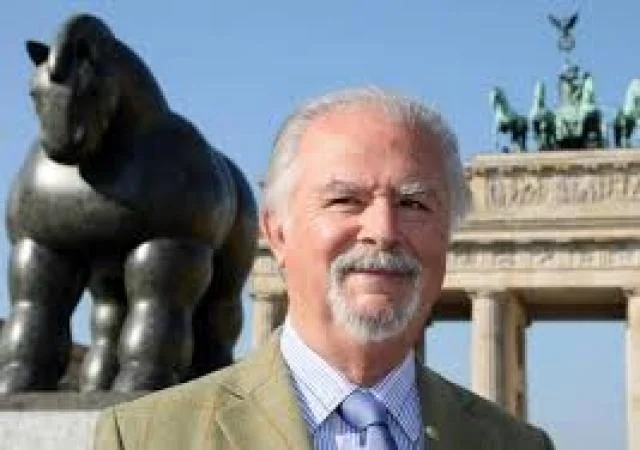
Fernando Angulo
Fernando Botero Angulo was a Colombian painter, draftsman and sculptor whose monumental figures became one of the most recognizable visual styles in modern Latin American art. His work ranges from playful scenes of daily life to portraits of political power and images of violence. The rounded forms that made him internationally famous were, for Botero, an exploration of volume rather than simply an exaggerated depiction of weight.
Early life and artistic formation
Botero was born in Medellín on April 19, 1932, the second of three sons of David Botero Mejía, a traveling salesman, and Flora Angulo, a seamstress. His father died when he was four. He attended the Jesuit-run Bolívar School and was still a teenager when his drawings first appeared in the newspaper El Colombiano. In 1951, after finishing secondary school, he moved to Bogotá and held his first solo exhibition at the Leo Matiz Gallery.
A painting he entered in Colombia’s 1952 National Artists’ Salon won second prize and helped finance a journey to Europe. He spent time at Madrid’s San Fernando Academy and Florence’s San Marco Academy, where he studied Renaissance art and the Italian Quattrocento. He later described himself as largely self-taught, shaped by museum visits, reading and long hours of painting. His close study of European masters would remain visible throughout his career, as he repeatedly reimagined familiar compositions in his own distinctive style.
Developing a signature style
After returning to Colombia in 1955, Botero won another major prize at the National Artists’ Salon in 1958. His mature style took shape over the following years. He enlarged figures and objects, giving them a powerful sense of volume and placing them in balanced, often sharply observed compositions. The paintings could be humorous, tender or satirical; scenes of clergy, politicians, military figures, families, musicians and everyday life all became part of his broad visual world.
Botero’s figures are often casually described as “fat,” but that shorthand misses his central concern with form. He treated volume as a way to transform reality, creating a world where people, animals and objects seem to occupy space with unusual weight and presence. His art drew on classical painting, popular and pre-Columbian traditions, and the streets and customs of Colombia. The distinctive approach was later widely called “Boterismo.”
In 1960, Botero moved to New York, where he spent more than a decade before settling in Paris in 1973. He also continued to return to Colombian subjects. His paintings addressed the country’s armed conflict and its consequences, including the 2000 work Masacre de Mejor Esquina. In 2004 and 2005, he made a series of paintings and drawings about the abuse of prisoners at Abu Ghraib in Iraq, using his characteristic visual language to condemn cruelty and abuse of power.
Sculpture, family and public legacy
From 1976, Botero increasingly worked in three dimensions as well as on paper and canvas. He made large bronze and marble sculptures, and exhibited a group of them at Paris’s Grand Palais in 1977. Later public exhibitions brought his monumental figures to major settings, including the Champs-Élysées in Paris and Fifth Avenue in New York. His subjects included not only people but also horses, cats and still lifes, all shaped by his fascination with volume.
Botero married cultural manager Gloria Zea in 1955, and they had three children. He later married Cecilia Zambrano; their son, Pedro, died in a car accident in Spain in 1974, aged four. The loss became part of the artist’s personal history and informed works dedicated to his son. In 1978, Botero married Greek sculptor and painter Sophia Vari, who became a close artistic companion.
His gifts to Colombia made his art accessible to the public in his home country. In 2000, he donated 208 works to the Banco de la República: 123 of his own and 85 by international artists. The collection formed the permanent basis of the Botero Museum in Bogotá. He also donated works to the Museum of Antioquia in Medellín, helping strengthen the cultural institutions of the city where he was born.
Botero died at his home in Monaco on September 15, 2023, aged 91. His legacy rests not only on an instantly recognizable style, but also on the breadth of subjects he took on: humor and everyday life, art history, family, political power and the suffering caused by violence.


