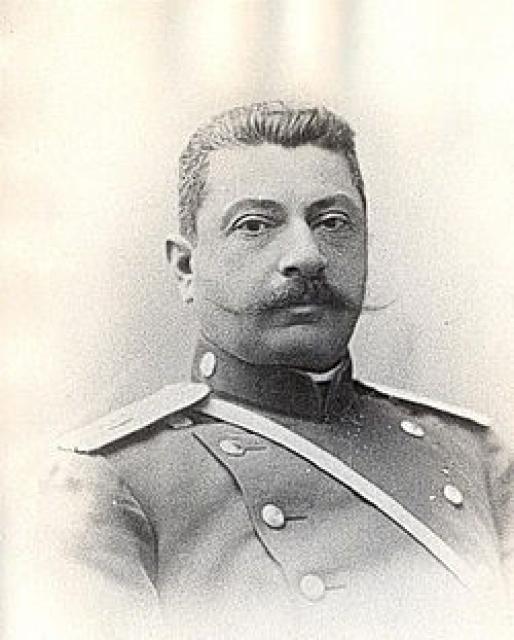
Firidun-bek Vezirov
 Azerbaijan
- Early Life and Education
- Military Career
- Promotions and Command
- Awards and Honors
- - Order of Saint Stanislaus, 3rd Class (January 19, 1882)
- Interrogation and Execution
- Personal Life
Early Life and Education
Firidun Bey Vezirovwas born on April 19, 1850, in Tiflis, Azerbaijan, into an aristocratic family. As a noble from the Tiflis province, he adhered to the Muslim faith. His father, Jamal-bey, served in the judiciary, while his mother, Esmet, was a homemaker. Vezirov received his general education at the Classical Gymnasium in Tiflis.
Military Career
Vezirov began his military service in April 1868 as an under-officer in the 7th Belorussian Hussar Regiment. In 1870, he graduated from the Elisavetgrad Cavalry Junker School and was returned to his regiment. He was promoted to Cornet on October 20, 1870, and to Lieutenant in March 1872. On March 5, 1874, he became a Staff-Captain, and on March 6, 1876, a Captain. On September 25, he was assigned to the alternate composition of the Training Cavalry Squadron. By imperial order, he transferred to the 15th Dragoon Tver Regiment on November 8, 1876.
In 1877, Captain Vezirov was appointed commander of the 4th Squadron. Under his leadership, the squadron successfully cleared enemy forces from the villages of Mehmetchi, Dobruji, Cobanköyü, Hajiouglu, and Bazar Düzyü.
Promotions and Command
On May 5, 1881, Vezirov was promoted to Major. In May 1882, he was appointed a member of the Caucasian Military District Court. On October 11, 1890, he was transferred to the 28th Novgorod Dragoon Regiment. For his distinguished service, he was promoted to Colonel on October 13, 1897.
On January 28, 1900, Vezirov was appointed commander of the 10th Novorossiysk-Ekaterinoslav Dragoon Regiment. He served in Warsaw, Rylsky, and other cities. During this period, Vezirov attained the rank of Major General. Eventually, he returned to Tiflis, where he resided at 111 Mikhailovskaya Street.
Awards and Honors
Throughout his career, Vezirov received numerous awards for his service:
- Order of Saint Stanislaus, 3rd Class (January 19, 1882)
- Order of Saint Anna, 3rd Class (May 6, 1889)- Order of Saint Stanislaus, 2nd Class
- Order of Saint Vladimir, 4th Class (September 22, 1898)
Post-Revolutionary Life
In early 1919, Vezirov received a letter in Tiflis that brought him to Baku. By order of the Minister of War, General Mekhmandarov, Vezirov was appointed commandant of Baku, temporarily assuming the duties of garrison commander on August 7, 1919.
After the Bolsheviks came to power, Vezirov was removed from his post. On June 2, 1921, he was arrested by the Azerbaijani Cheka. He was accused of belonging to the "Islam" party and participating in the Ganja uprising.
Interrogation and Execution
During interrogation, Vezirov denied any wrongdoing. He admitted working as a special operations agent with Aligeidar Garayev, but claimed he had no knowledge of any plot. Despite his plea of innocence, Vezirov was ordered released on June 19, 1921, by order of the Chairman of the Council of People's Commissars of Azerbaijan, Nariman Narimanov.
However, on June 30, 1925, Vezirov was executed at the age of seventy-five. Notably, his execution occurred after the death of Narimanov.
Personal Life
Vezirov was married twice. His first wife, Zinaida Selimovna Krichinskaya, was the daughter of a retired colonel. They had a daughter named Nigyar, who was born on December 22, 1902. Vezirov's second wife and daughter were also of the Muslim faith.



