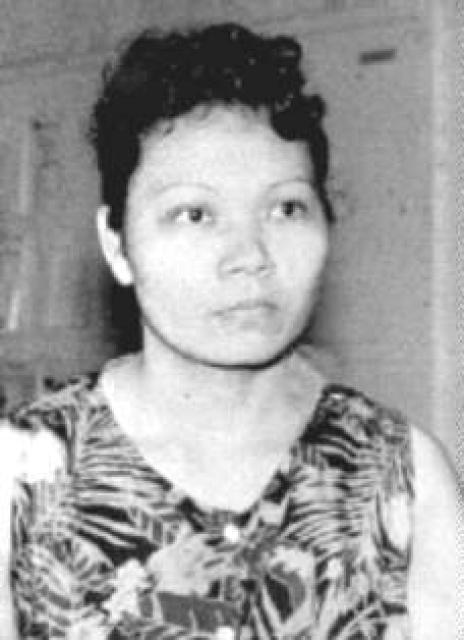
Flor Contemplacion
 Philippines
Biography of Flor Contemplacion
Flor R. Contemplacion was born in January 1953 in San Pablo City, Laguna, Philippines. She worked as a Filipino domestic helper in Singapore. Her execution caused significant tension in the relationship between Singapore and the Philippines. Many Filipinos openly expressed their disappointment with both their own government and the Singaporean government for turning a blind eye to the suffering, mental anguish, and helplessness that many Filipino workers face around the world.
The Murder Case
On May 4, 1991, a four-year-old boy named Nicholas Huang, whom Flor was looking after, was found drowned in Singapore. Delia Maga, a Filipino domestic helper, was also found strangled to death on the same day. Although the boy's father could not identify any suspects, the police discovered Flor Contemplacion's name in Delia's diary. During the interrogation, Flor confessed to the murders of Delia and the child. She never recanted her statement, and the Philippine embassy in Singapore considered her confession to be credible. Consequently, she was sentenced to death by hanging. However, there was no medical examination, no argument between the prosecution and defense during the trial, despite the details of the peculiar circumstances she described in her confession.
Appeal and Controversy
During the appeal process, the case was coincidentally heard by the same judge, who wanted to hear the details of the forensic examination. The defense presented a medical certificate, claiming that Flor had a partial epilepsy seizure at the time of the murder, while the prosecution insisted that she only had a minor headache that day. The judge sided with the prosecution, and Contemplacion was once again found guilty and sentenced to death. Shortly before her execution, two Filipino witnesses claimed that the boy's father framed Flor Contemplacion. They alleged that he killed Delia in a fit of rage after his son accidentally drowned. According to their testimony, the boy was an epileptic who had a seizure while in the bathtub, and Maga was unaware of this. The court heard and dismissed these testimonies. Despite a personal appeal from Philippine President Fidel Ramos to the Singaporean government, the execution still took place.
Public Reaction and Legacy
Ramos referred to Contemplacion as a heroine, and his wife, Amelita Ramos, volunteered to receive her coffin at the Ninoy Aquino International Airport in Manila. The president sent a wreath to her funeral and offered financial assistance to her children, who were presumably heavily dependent on their mother's income as a domestic helper. Many Filipinos believe that Contemplacion was innocent or, at the very least, suffered from mental incapacity if she committed the murders. They accuse the Singaporean government of lacking mercy and argue that their own government did too little to stop the execution. The Philippine embassy in Singapore, in particular, faced harsh criticism for not having a representative present throughout the trial. The Alex Boncayao Brigade, a communist terrorist group in the Philippines, threatened to punish Singapore and Filipino officials. The Catholic Church, which holds significant influence in the Philippines, condemned the execution. Regardless of Contemplacion's guilt or innocence, her name became a symbol of the struggle against inhumane, degrading, and exploitative working conditions faced by many Filipino domestic helpers and other workers abroad.
A film titled 'The Flor Contemplacion Story' was made in the Philippines, highlighting not only her execution but also the severe punishments imposed on Filipino workers abroad when they fail in their jobs. The film won the Best Picture award at the Cairo Film Festival. A similar incident that further fueled the anger of the Filipino people occurred a few months after Contemplacion's execution when Sarah Balabagan, a domestic helper in the United Arab Emirates, killed her employer, claiming self-defense against attempted rape. However, in this case, the death penalty was commuted to imprisonment and 100 lashes with a cane. Balabagan returned to the Philippines on August 1, 1996, hailed as a hero.


