
Francis Bacon
 Great Britain
- Francis Bacon: A Renowned English Philosopher, Jurist, and Statesman
- Legal and Political Career
- Accession of James I and Rise to Prominence
- Fall from Grace and Impact of the Bribery Scandal
- Literary Contributions
- Other Works
- "Novum Organum" (1620): The foundation of Bacon's inductive method.
- Philosophical Legacy
- Establishment of the "Organon"
- Scientific Legacy
- Legacy and Influence
Francis Bacon: A Renowned English Philosopher, Jurist, and Statesman
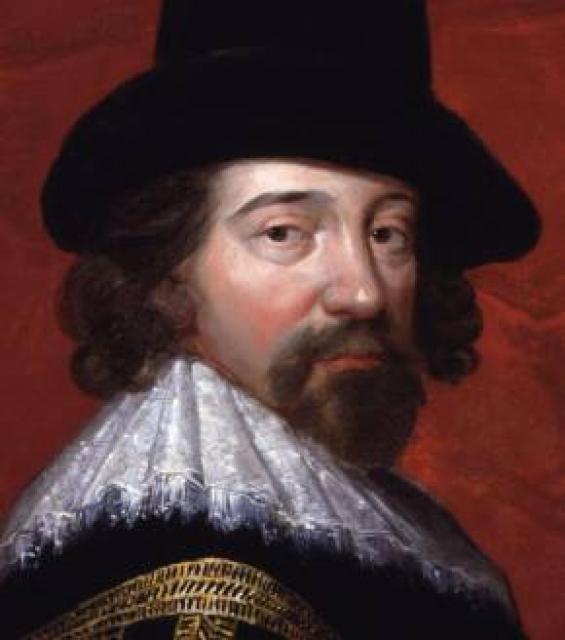
Early Life and EducationFrancis Bacon was an English philosopher, jurist, and statesman born in London on January 22, 1561. He was the youngest son of Sir Nicholas Bacon, Lord Keeper of the Great Seal. Bacon studied at Trinity College, Cambridge, for two years and then spent three years in France as part of the English ambassador's entourage.
Legal and Political Career
After his father's death in 1579, Bacon was left with limited financial resources. He entered Gray's Inn to study law and was called to the bar in 1582. Bacon became a member of Parliament in 1584 and played an active role in the House of Commons until 1614. He advocated for impartiality in political matters and sought to address conflicts between the Crown and Parliament. Despite his abilities, he faced challenges in advancing his career due to opposition from Lord Burghley and Queen Elizabeth I.
Accession of James I and Rise to Prominence
The accession of James I to the throne in 1603 marked a turning point in Bacon's career. He was knighted in 1603, and his fortunes rose rapidly. In 1607, he was appointed Solicitor General, followed by Attorney General in 1613. In 1617, he became Lord Keeper of the Great Seal and was elevated to the position of Lord Chancellor in 1618, the highest judicial office in England. Bacon also received titles of Baron Verulam (1618) and Viscount St Albans (1621).
Fall from Grace and Impact of the Bribery Scandal
In 1621, Bacon was accused of accepting bribes. While he admitted receiving gifts, he denied that they influenced his judgments. Nevertheless, he was impeached, removed from office, and barred from the court. Bacon spent the remaining years of his life in retirement.
Literary Contributions
"Essays"Bacon's literary masterpiece is his "Essays," a collection of short, contemplative pieces on various topics. Initially published in 1597, the final edition contained 58 essays and was titled "The Essayes or Counsels, Civill and Morall." The essays display a keen understanding of human nature and provide practical advice for those seeking advancement.
Other Works
Bacon's other notable works include:"De Sapientia Veterum" (1609): An allegorical interpretation of ancient myths.
"Historie of the Raigne of King Henry the Seventh" (1622): A historical analysis of Henry VII's reign.
"Novum Organum" (1620): The foundation of Bacon's inductive method.
"Of the Proficience and Advancement of Learning" (1605): A treatise on the importance and advancement of knowledge.
"The New Atlantis" (1627): A utopian novel depicting a society dedicated to scientific inquiry.
Philosophical Legacy
Critique of Aristotelianism and the Scientific MethodBacon rejected the dominant Aristotelian deductive approach to philosophy. Instead, he advocated for an inductive method that emphasized observation and experimentation. He identified four types of "idols" that hinder clear thinking and outlined a three-part division of knowledge: history, poetry, and philosophy.
Establishment of the "Organon"
Bacon proposed a "new organon," a method for acquiring true knowledge. His plan called for six parts, including an analysis of current knowledge, a description of the new method, and a collection of empirical data. While Bacon only completed two parts, his work influenced the development of scientific methodology.
Scientific Legacy
Bacon's belief in the importance of observation and experimentation placed him among the pioneers of modern scientific thought. His call for empirical research and the rejection of authority paved the way for the Scientific Revolution. However, his inductive method, based on the exclusion of alternative hypotheses, did not gain widespread acceptance in experimental science.
Legacy and Influence
Francis Bacon's contributions to philosophy, literature, and jurisprudence have had a profound impact on Western thought. His ideas continue to inspire scholars and researchers to this day. The London Royal Society, established in 1662, is often viewed as a testament to his vision for a scientific community dedicated to the advancement of knowledge.


