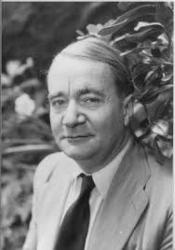
Francis Parker Yockey
 USA
USA- Early Life and Influences
- Neo-Spenglerianism and the Notion of "Empire"
- Political Activism and Extremism
- Global Travels and Anti-Americanism
- FBI Surveillance and Imprisonment
- Legacy and Controversies
Francis Parker Yockey: A Controversial American Philosopher and Political Thinker
Early Life and Influences
Francis Parker Yockey (pen name Ulick Varange) was born in Chicago, Illinois, in 1917. His family later moved to their farm in Ludington, Michigan, during the Great Depression. Yockey's parents were Anglophile intellectuals who instilled in him a love for European culture and high art.
Yockey's early political leanings were influenced by the works of Marxist scholars. However, he later became disillusioned with Marxism and turned towards the writings of German philosopher Oswald Spengler, who advocated for an elitist, anti-materialist worldview. Yockey also drew inspiration from the ideas of German jurist and political theorist Carl Schmitt.
Neo-Spenglerianism and the Notion of "Empire"
In 1948, Yockey published his magnum opus, "Empire: A Philosophy of History and Politics" (under the pen name Ulick Varange). This 600-page treatise argued for a culture-based, totalitarian path for preserving Western civilization.
Yockey's concept of "Empire" rejected the biological notion of race prevalent in Nazi ideology. Instead, he proposed a spiritual concept of race, linked to Carl Haushofer's geopolitical ideas. He believed that Western culture was under threat from both international Jewry and Soviet communism and that only a culturally rooted totalitarian regime could save it.
Political Activism and Extremism
Throughout his life, Yockey remained active in ultra-right circles worldwide. He wrote political essays for publications like "Social Justice," edited by the anti-Semitic Catholic priest Father Charles Coughlin.
Yockey's views placed him at odds with many other far-right figures. He supported the alliance of extreme left and extreme right ideologies, which was rejected by groups like George Lincoln Rockwell's American Nazi Party. Some, such as Colin Jordan, accused Yockey of promoting a form of "New Strasserism" that undermined true Nazism.
Global Travels and Anti-Americanism
After World War II, Yockey's anti-Western views intensified. He traveled extensively, seeking to establish connections with both communist and fascist regimes. He met with Egyptian President Gamal Abdel Nasser, worked for the Egyptian Ministry of Information, and visited Cuba after Fidel Castro's revolution.
Yockey's anti-Americanism led him to believe that the Soviet Union's purge of Jews under Stalin constituted a "break" with international Jewry. He sought to forge alliances between communist and far-right forces against the perceived threat of American imperialism.
FBI Surveillance and Imprisonment
Yockey's activities attracted the attention of the Federal Bureau of Investigation (FBI), which pursued him for over a decade. He assumed numerous aliases and fled abroad to evade capture.
In 1960, Yockey was arrested at an airport after his suitcase, containing forged passports and birth certificates, was mistakenly sent to the wrong destination. He was imprisoned in San Francisco, where he was found dead in his cell with an empty cyanide capsule. Yockey left a note claiming suicide to protect the anonymity of his political contacts.
Legacy and Controversies
Francis Parker Yockey's writings continue to be influential within certain far-right and neo-fascist circles. His ideas have been cited by groups like the National Alliance. However, Yockey's anti-Semitism and extremist views have also been widely condemned. He remains a controversial figure in the history of American political thought.