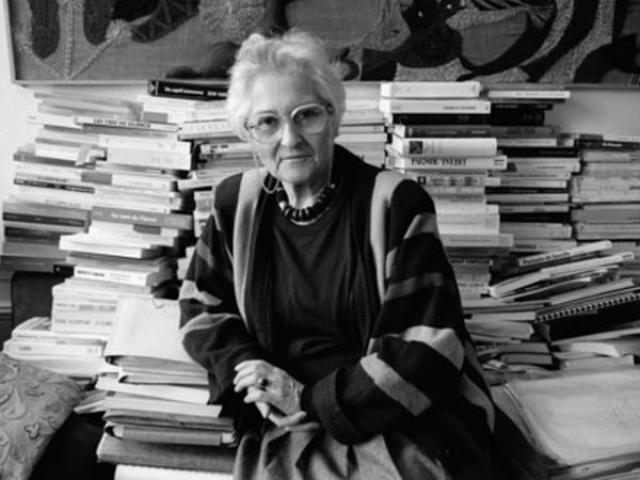
Francoise Dolto
 France
- Biography of Françoise Dolto
- The Path of an Analyst
- The Unconscious Body Image and Symbolic Castrations
- The Green House
Biography of Françoise Dolto
Françoise Dolto, a French psychoanalyst and pediatrician, was one of the key figures in French psychoanalysis, particularly in child psychoanalysis. She was renowned for her exceptional clinical skills and became well-known for introducing and conceptualizing the notion of the "unconscious body image." Dolto also conducted significant work for the "Cause of Children." Her legacy includes radio broadcasts, books, numerous lectures and seminars, the creation of the "Green House," the supervision of the experimental school of Noville, participation in the preparation of the Convention on the Rights of the Child, and much more. Her contributions played a crucial role in ensuring that the voice of the child could be heard by adults.
Françoise Dolto was born on November 6, 1908, in Paris, into a wealthy bourgeois family. She was the fourth of seven children, with two sisters and five brothers. From a young age, Dolto displayed a lively and inquisitive mind, observing and questioning adults about their words, actions, and explanations, often leaving them perplexed. At the age of eight, she dreamed of becoming a "doctor-educator" to prevent children from suffering from the "misunderstandings of adults."
However, her family experienced tragedy with the sudden death of her older sister, Jacqueline, at the age of 18 from cancer. This death became a true tragedy for Dolto's mother, who fell into "pathological mourning," and their family life was never the same. Much of the blame and disappointment from this loss fell on young Françoise. Her mother strongly opposed her desire to become a doctor and made every effort to ensure that Dolto followed the ideals of their social circle and her time, becoming an exemplary wife, mother, and homemaker. Dolto's journey towards education and independence would be long (she was only able to enter nursing school at age 25) and would become a path of self-formation, clarification of her aspirations, and the affirmation of her desire.
Boris Ivanovich Dolto, originally from Russia (born in Simferopol), emigrated to Turkey in 1918 and then to Paris, where he received a medical degree in rheumatology. He became the creator of a new medical discipline called kinesiotherapy (movement therapy) and the founder of the French School of Massage and Orthopedics. Their remarkable creative partnership enriched the thoughts and work of both, leading to a deeper understanding of the complex and diverse interaction between the body and the psyche. The Dolto family had three children: Jean-Christophe (a singer known as "Carlos"), Gregoire (a shipbuilding engineer), and Catherine (a doctor specializing in speech therapy).
Françoise Dolto left behind more than a dozen books, the vast majority of which she wrote after her husband's death in 1981. She passed away on August 25, 1988, at the age of 79. On her tombstone, she requested the engraving of the dates of her husband's life and the words from the Gospel: "N'ayez pas peur, je suis le chemin, la vérité et la vie" St. John (14, 6).
The Path of an Analyst
After completing her studies and defending her medical dissertation titled "Psychoanalysis and Pediatrics" in 1939, Françoise Dolto dedicated herself to psychoanalytic work until her death in 1988. She considered Sophie Morgenstern, the first child psychoanalyst in France, a specialist in children's drawings, as her teacher in working with children. Morgenstern's approach focused on creating an atmosphere of trust so that children could speak openly without fear of their words being repeated to adults.
In 1938, Dolto became a member of the Paris Psychoanalytic Society (SPP). However, like Jacques Lacan, the International Psychoanalytic Association (IPA) prohibited her from participating in the training and education of young psychoanalysts, including teaching and conducting didactic analyses. This decision followed a decade of conflicts, negotiations, and confrontations with the IPA, which began when Dolto, Daniel Lagache, and Juliette Favez-Boutonier, dissatisfied with the authoritarian style of Sasha Nacht, who concentrated control of the Institute of Psychoanalysis and the Paris Psychoanalytic Society in his hands, left the Paris Psychoanalytic Society (SPP) and founded a new psychoanalytic organization, the French Psychoanalytic Society (SFP). Jacques Lacan joined them. However, their departure automatically suspended their membership in the International Psychoanalytic Association, which triggered a struggle for recognition and accreditation. This work concluded with the committee chaired by Turke's definitive decision to exclude Dolto and Lacan from the list of training analysts. This prompted Lacan to leave the SFP and establish the Paris School of Freudianism (EFP) in 1964, to which Françoise Dolto immediately joined. Throughout her life, she maintained a friendly and working relationship with Jacques Lacan, characterized by mutual respect and a long institutional path. In 1980, after the dissolution of the School, Dolto faced sharp criticism from her colleagues for being suspected of attempting to take on the leadership of French psychoanalysis. The main criticism, resembling more of a witch-hunt, was directed at her "popularization" of psychoanalysis through the radio series "When a Child Appears," which she hosted on Radio France-Inter from 1976 to 1977, and her openly acknowledged religious sense (in 1977, she published the book "The Gospel through the Prism of Psychoanalysis"). While she earned her reputation as a brilliant practitioner rather than a theorist due to her preference for "clinical testimony" over theoretical studies and her unwavering dedication to oral transmission, Dolto always had clear logic and conceptual clarity underlying all her interventions and words. She aimed to convey this clarity to young analysts in her seminars on child psychoanalysis. In this work of transmitting analytical experience, Dolto invented a new form of training, allowing future practitioners to actively participate in the conduct of analytical sessions with children. She trained generations of analysts, and her work and approach significantly influenced the fundamental transformation of work with children in nurseries, hospitals, maternity wards, and orphanages. A whole generation of French children would be raised on the "ideas of Dolto," reducing her nuanced and complex thoughts to easily reproducible recipes and caricatured simplifications.
Her works and ideas are being rediscovered today, and in 2008, a series of scientific and cultural events were held in France to celebrate Dolto's centennial anniversary. In 1990, the "Françoise Dolto Documentary Archive" was created, open to researchers and anyone interested in Dolto's work.
The Unconscious Body Image and Symbolic Castrations
Through her extensive analytical practice and work in child consultations at the Trusseau Clinic (1940–1978) and the Etienne Marcel Center (1962–1985), Dolto developed her own method of working with children, paying particular attention to the earliest, "archaic" period of a child's life. She viewed all their life manifestations – somatics, communication, and affects – as messages that needed to be deciphered and translated into language. Her theory of the "unconscious body image" was an attempt to understand the non-verbal richness of bodily experience that is laid down from the moment of a child's birth. This body image was a living and dynamic synthesis of a child's emotional and physical experiences, a kind of unconscious symbolic incarnation of the desiring subject that exists and is structured through relationships with others. Dolto considered every human being as carrying within them the unique desire to live, grow, and develop. She advocated for the respect of each individual's desire, even the smallest child, without implying the satisfaction of all their requests and wishes. According to Dolto, responsible self-perception and relationships with others could only be established through language, open communication, and the sharing of knowledge about the child's place in the world, its rules, and its laws. She proposed the concept of "symbolic castrations," suggesting that at each stage of a child's psychological and physical development, there are moments when they must confront the limitation of their desires and their inability to realize them. These moments are difficult and tormenting for the child but also reveal that culture and civilization impose restrictions not on desire itself but on the unacceptable means of its realization. They offer alternative, sublimated ways of achieving desires that have been developed throughout history in the context of collective existence.
The Green House
Françoise Dolto played an active role in the creation of the Green House in 1979, together with Pierre Benoit, Colette Lonjilon, Marie-Hélène Malandrin, Marie-Noëlle Reboa, and Bernard Tisso. Until her death, Dolto contributed her analytical experience and knowledge to this open social space, where anyone preparing or already becoming a parent could come. The Green House was conceived as a place for relaxation, communication, and interaction with other children and adults. It was open to children aged 0 to 4 accompanied by adults or expectant parents. The Green House provided a space for discussing everyday caregiving concerns and parenting challenges, enabling individuals to establish their relationship with the world from the earliest moments of life. It was a "partnership space with parents, guaranteeing anonymity not in the sense of impersonal reception, but rather with the idea that children should not be judged or compared." The Green House's model of work gained recognition from children, parents, and professionals, and over its 30 years of existence, it spread widely in France and internationally.


