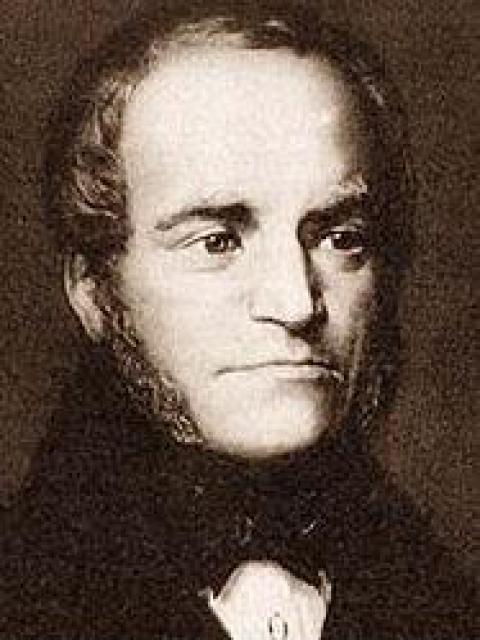
Franz Gerstner
 Austria
- Early Life and Education
- Engineering Career in Austria
- Invitation to Russia and Vision for Railway Development
- Approval for the Tsarskoye Selo Railway
- Construction and Opening of the Tsarskoye Selo Railway
- Advocacy for American Engineers
- Passing of the Torch and Legacy
Early Life and Education
Franz Anton Ritter von Gerstner, the Austrian engineer who constructed Russia's first railway, was born in Prague, the fourth child of Franz Joseph von Gerstner and Gabriela. After his mother's passing when he was 12, Gerstner pursued studies in philosophy and engineering at Prague University.
Engineering Career in Austria
Upon completing his education, Gerstner taught practical geometry and surveying at the Vienna Polytechnic Institute. He aspired to build a railway between the Vltava and Danube rivers, for which he traveled to England to observe the construction of the country's early railways. In 1824, Emperor Franz II of Austria granted him a concession to build and operate a railway between Budweis and Mauthausen. By 1832, the railway was completed, solidifying Gerstner's reputation as a prominent Austrian engineer and professor at the Vienna Polytechnic Institute.
Invitation to Russia and Vision for Railway Development
In 1834, Gerstner arrived in Russia to survey mining plants. Inspired by the potential for railway development in the vast country, he spent three months collecting data and analyzing the economy, infrastructure, and mining industry. In early 1835, he presented a memorandum to Emperor Nicholas I, outlining his vision for a network of railways connecting major cities.
Gerstner's proposal emphasized the significant benefits of railways in reducing travel time and improving transportation efficiency. He suggested a railway line between St. Petersburg and Moscow, as well as connections to Kazan, Nizhny Novgorod, and ultimately Odessa.
Approval for the Tsarskoye Selo Railway
Gerstner's proposal was met with skepticism regarding its financial feasibility. However, he was granted permission to construct a smaller project: the Tsarskoye Selo Railway. On April 15, 1836, Emperor Nicholas I issued a decree authorizing its construction.
Construction and Opening of the Tsarskoye Selo Railway
In November 1836, a trial run of a locomotive between Pavlovsk and Tsarskoye Selo took place in freezing temperatures, with Nicholas I and a large audience present. The official opening of the Tsarskoye Selo Railway occurred on October 30, 1837.
Advocacy for American Engineers
Gerstner's 1838 mission to America, commissioned by the Russian government, convinced him of the expertise of American engineers in railway construction. He recommended their involvement in the upcoming St. Petersburg-Moscow railway project. Emperor Nicholas I sent engineers to Western Europe and the United States to investigate further.
Passing of the Torch and Legacy
Gerstner passed away in Philadelphia in 1840, and his monument was unveiled in St. Petersburg in 2007 to commemorate the 170th anniversary of Russian railways. His legacy as the father of Russian railways remains intact. The Nikolaev Railway, connecting the two Russian capitals, was completed by George Washington Whistler, an American engineer who benefited from Gerstner's pioneering work.