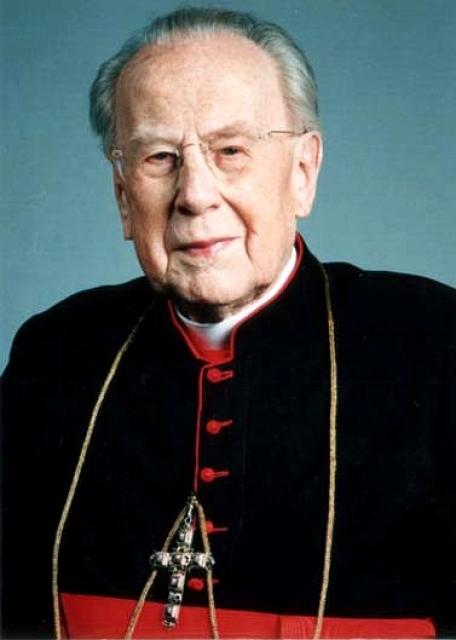
Franz Konig
 Italy
Italy- Early Life and Education
- Priestly Career and Academic Life
- Ecclesiastical Ascendancy
- Interfaith Engagement and Ecumenism
- Role in the Election of Pope John Paul II
- Later Years and Legacy
Early Life and Education
Franz König was born on August 3, 1905, in Wart, a small village near Rabenstein, Lower Austria. He was the eldest of nine children born to Franz and Maria König. The future Cardinal König attended Catholic school at the Stiftsgymnasium in Melk, a Benedictine abbey. He later studied in Rome at the Pontifical Gregorian University, where he earned a doctorate in philosophy in 1930 and a doctorate in theology in 1936. He also studied at the Pontifical German-Hungarian College, the Pontifical Biblical Institute (where he learned Ancient Syriac and ancient Persian religions), and the Catholic University of Lille, France.
Priestly Career and Academic Life
König was ordained a priest on October 29, 1933, in Rome by Cardinal Francesco Marchetti Selvaggiani, Vicar General of Rome. From 1933 to 1936 and 1938 to 1945, he served as a priest in various parishes in St. Pölten. He then pursued an academic career at the universities of Vienna and Salzburg (first as a private lecturer and later as a professor at the University of Salzburg).
Ecclesiastical Ascendancy
In 1952, König was appointed Coadjutor Bishop of St. Pölten with the right of succession to the diocese. He was consecrated on August 31, 1952, by Bishop Michael Memelauer of St. Pölten. On May 10, 1956, Franz König was appointed successor to Cardinal Theodor Innitzer as Archbishop of Vienna and Primate of Austria. This position would have automatically led to his elevation to cardinal, but it did not occur under Pius XII. It was only on December 15, 1958, that König was finally created a cardinal at the first consistory of John XXIII, receiving the title of the Church of Sant'Eusebio. From 1959 to 1968, he also served as Military Vicar of Austria.
Interfaith Engagement and Ecumenism
Within the Church, König was particularly interested in ecumenism. From April 6, 1965, to June 27, 1980, he headed the Vatican Secretariat for Non-Christians. In this role, König visited Poland, Romania, and Yugoslavia, where he met with representatives of local Orthodox churches. In 1975, he paid a visit to Coptic Patriarch Shenouda III in Egypt, and in 1978, he met with the Orthodox Patriarch of Syria in Damascus. In 1980, he met with Vasken I, Catholicos of the Armenian Apostolic Church, in Moscow.
Role in the Election of Pope John Paul II
Cardinal König played a key role in the election of Archbishop Karol Wojtyła of Kraków as Pope. Wojtyła, who took the name John Paul II, became the first non-Italian pope in over 450 years.
Later Years and Legacy
König's successor as Archbishop of Vienna was Hans Hermann Groër, a man whose appointment König had no part in and who was eventually forced to resign by Pope John Paul II amid a sexual abuse scandal. Until his death, Cardinal König remained active in the Archdiocese of Vienna, which is now under the care of the current Archbishop of Vienna, Cardinal Christoph Schönborn, who was ordained a priest by König himself. In 2003, while on vacation, König suffered a bad fall and broke his hip but made a quick recovery and celebrated Mass again a few months later.
König died in his sleep on March 13, 2004, at the age of 98, in the convent of the Sisters of Mercy in Vienna, where he resided. He was buried in St. Stephen's Cathedral in Vienna. Cardinal König was the last surviving cardinal created by Pope John XXIII.


