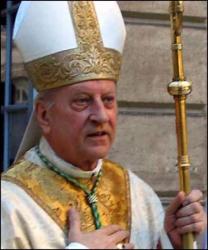
Thomas Collins
 Canada
- Childhood and Education
- Priest, Teacher, and Scripture Scholar
- From Alberta to Toronto
- Public Voice and Later Years
Thomas Collins’s path from a Guelph parish to the leadership of Canada’s largest Catholic archdiocese began with an English teacher who recognized a vocation he had not yet considered. Trained in literature and theology, he became a priest, scripture scholar, seminary rector, bishop, and eventually a cardinal. As Archbishop of Toronto from 2007 to 2023, he led a major urban church while also taking on responsibilities at the Vatican and speaking publicly about the place of Catholic teaching in Canadian life.
Childhood and Education
Born on January 16, 1947, in Guelph, Ontario, Collins grew up in a Catholic family. His father managed circulation for the local Guelph Mercury newspaper, and his mother worked as a legal secretary. The youngest of three children and the only son, he lived near the Church of Our Lady, where he attended Mass and served at morning services.
At Bishop Macdonell Catholic High School, Collins considered careers in teaching or law. His Grade 11 English teacher, Father Newstead, encouraged him to consider the priesthood. Collins studied English at St. Jerome’s College in Waterloo, receiving a bachelor’s degree in 1969. He then attended St. Peter’s Seminary in London, Ontario, earning a Bachelor of Theology in 1973, and completed a master’s degree in English at the University of Western Ontario that same year.
His intellectual interests eventually centered on Scripture, especially the Book of Revelation. In Rome, he studied at the Pontifical Biblical Institute, earning a licentiate in Sacred Scripture in 1978, and later completed a doctorate in theology at the Pontifical Gregorian University in 1986. His dissertation examined the final verses of Revelation as a focal point for the book’s moral teaching.
Priest, Teacher, and Scripture Scholar
Collins was ordained a priest for the Diocese of Hamilton on May 5, 1973. His early ministry included parish work in Burlington and Hamilton, teaching and chaplaincy at Cathedral Boys’ High School, and academic appointments. After returning from Rome, he lectured in English at King’s College and in Scripture at St. Peter’s Seminary. There he also served as a spiritual director and professor, becoming dean of theology and vice-rector in 1992.
In 1995, he was appointed rector of St. Peter’s Seminary. He had spent years teaching future clergy and helping shape the seminary’s intellectual and spiritual life. Alongside his academic work, he wrote reflections and pastoral material, including an essay on the relationship between the Bible and the liturgy. His deep attention to Revelation became a distinctive thread in his public identity as a church leader and biblical scholar.
From Alberta to Toronto
In 1997, Collins was appointed coadjutor bishop of Saint Paul, Alberta, and was ordained a bishop that May. He became the diocese’s bishop in June. Two years later he was appointed coadjutor archbishop of Edmonton and succeeded as archbishop that September. In Alberta, he held leadership roles in the provincial bishops’ conference and national church bodies, including the Canadian Catholic bishops’ theological commission. He also helped organize preparations for World Youth Day 2002 in Toronto, then served as apostolic administrator of Saint Paul while leading Edmonton.
Pope Benedict XVI appointed Collins Archbishop of Toronto in December 2006, and he was installed in January 2007. Toronto’s archdiocese is one of the country’s largest and most diverse Catholic communities. The role brought a broad administrative portfolio: he served as chancellor of the University of St. Michael’s College and the Pontifical Institute of Mediaeval Studies, chaired boards supporting seminary education and Catholic charities, and became president of the Assembly of Catholic Bishops of Ontario in 2008.
The cardinal’s work extended beyond Canada. He participated in the Synod of Bishops on the Eucharist and the special assembly for the Middle East, served as an apostolic visitor in Ireland, and worked on the Vatican’s provision for Anglicans entering full communion with the Catholic Church. He also served on Vatican bodies concerned with social communications and Catholic education. In 2012, Benedict XVI elevated him to the College of Cardinals, assigning him the titular church of San Patrizio in Rome. He took part in the 2013 conclave that elected Pope Francis.
Public Voice and Later Years
Collins became known for a direct public defense of Catholic doctrine and institutions. In 2015, he was named among a group of cardinals who raised concerns with Pope Francis about the process and working document for the Synod on the Family. Reports about the letter drew considerable attention, and its publication prompted debate over both the synod’s procedures and the cardinals’ aims.
In 2020, after trustees of the Toronto Catholic District School Board stopped a delegate from reading a passage of the Catechism at a meeting, Collins wrote a sharply worded letter to the board’s chair. He argued that trustees had responsibilities to the Church’s teaching, and his intervention became part of a wider public disagreement over religious doctrine, inclusion, and governance in Catholic schools. The episode reflected his conviction that church institutions should be able to state their beliefs plainly, even in contentious settings.
Collins submitted his resignation after reaching the age at which bishops customarily tender it, and Pope Francis accepted it on February 11, 2023. He became Archbishop Emeritus of Toronto after sixteen years leading the archdiocese. His legacy joins scholarly devotion to Scripture, decades of formation work in seminaries, leadership in Catholic institutions, and a visible willingness to enter public debates about how religious teaching should be represented in civic life.