Franz Rosenzweig
 Germany
Biography of Franz Rosenzweig
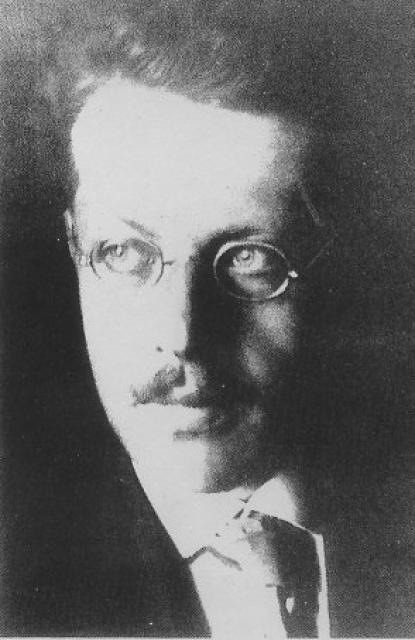
Franz Rosenzweig was a German-Jewish philosopher who is known for his contribution to 20th-century philosophy with the development of a systematic doctrine of dialogical "new thinking." Unlike the "old" classical thinking, Rosenzweig's new thinking is not concerned with abstract and eternal universal concepts, but rather with speech thinking in time.
Rosenzweig was born into a family that was not deeply rooted in traditional Judaism. He was the only son of Georg Rosenzweig, a wealthy industrialist and member of the city council in Kassel. As a result, Rosenzweig had little familiarity with Judaism in his youth. He completed high school in Kassel and began studying medicine in 1906 at the universities of Göttingen, Munich, and Freiburg. However, after a few semesters, he switched his focus to subjects that interested him more, such as history and philosophy, at the universities of Freiburg and Berlin. Historian F. Meinecke had a significant influence on Rosenzweig's spiritual development.
In 1910, Rosenzweig began studying the political teachings of G.W.F. Hegel. His doctoral dissertation (1912) became one of the sections of his later work "Hegel and the State" (published in 1920), which was more historical than philosophical. Despite intense debates with his friends and relatives who had converted to Christianity and tried to convince Rosenzweig of the superiority of Protestantism over Judaism, Rosenzweig decided to convert to Christianity in July 1913. However, he emphasized that this was not a renunciation of Judaism but an affirmation of it since Christianity, in his view, is a continuation and fulfillment of Judaism. Shortly before his conversion, Rosenzweig accidentally visited a small orthodox synagogue in Berlin on Yom Kippur. This experience deeply moved his religious feelings, and he left with a firm determination to remain faithful to the Jewish religion.
The next day, Rosenzweig told one of his friends that after what he had experienced, he could not live a normal life again. From that moment on, he devoted himself to the serious study of Jewish heritage. He began learning Hebrew, reading the Bible in its original language, attending lectures by Herman Cohen, and studying Jewish religious philosophy under his guidance. During World War I (1914), Rosenzweig volunteered for the front.
In 1916, he corresponded with his friend and Christian convert, legal historian O. Rosenstock-Huessy, who served on another front. This correspondence was later published in 1929 under the title "Letters of a Non-Zionist to an Anti-Zionist." Rosenstock-Huessy's main idea that revelation, the intrusion of the Divine into history, is the point around which people organize their world, became the basis of Rosenzweig's religious worldview. During the war, Rosenzweig also sent postcards from the front, which later formed the basis of his major philosophical work, "The Star of Redemption" (published in 1921). It analyzes the philosophical theology of Judaism and Christianity.
After the war, Rosenzweig continued his personal return to Judaism. Unlike Martin Buber, Rosenzweig believed that his return to Judaism should be accompanied by observance of the commandments. He even wrote an article criticizing Buber's unfavorable attitude towards traditional Jewish way of life.
In 1920, with the help of a group of Jewish intellectuals, including Orthodox Rabbi N. Nobel, doctor R. Koch, chemist E. Strauss, M. Buber, A. E. Simon, E. Fromm, G. Scholem, and N. Glazer, Rosenzweig organized the "Free Jewish House of Study" (Das Freie Jüdische Lehrhaus) in Frankfurt. Its goal was to study the Jewish way of life in the modern world. Teachers and students, regardless of their academic level, were equally eager to acquire basic Jewish knowledge.
In 1922, at the age of 36, Rosenzweig fell seriously ill with a form of paralysis that left him almost completely immobile and unable to speak. However, he continued to work, using eye signals to dictate a significant portion of his writings, primarily to his friend Martin Buber. He dictated his philosophical work "New Thinking" (1925) to his wife using only his eyes, even after complete paralysis.
On December 10, 1929, at the age of almost 43, Franz Rosenzweig, shattered by paralysis, passed away prematurely in Frankfurt am Main. During his illness, Rosenzweig translated the poetry of Judah Halevi into German. In his translations, he examined the religious and philosophical issues of the poet's work.
Rosenzweig also made a significant contribution to the new translation of the Bible into German in collaboration with Martin Buber (1924). The joint translation was completed up to the book of Isaiah and was published in 1925 in ten volumes under the title "Scripture." After Rosenzweig's death, Buber completed the translation in Israel. The main principle of this translation was the idea of the unity of the origins of all languages, which made it possible to search for a common etymological basis for words in different languages. The German language used in the translation was as close as possible to the language of the original text, and the translators aimed to reproduce the characteristics of the biblical text associated with its oral nature. However, unlike Martin Luther's traditional translation, this translation was not literal. The translators sought to create a literary translation primarily for German readers while taking into account traditional commentaries and biblical criticism. They rendered the four-letter name of God (Tetragrammaton) in the spirit of their dialogical philosophy, using personal pronouns ("Thou," "He").
The Buber-Rosenzweig Society for Jewish-Christian Dialogue in Germany awards the Buber-Rosenzweig Medal each year for significant contributions to the dialogue between Jews and Christians.
Rosenzweig's ideas had a profound influence on Jewish religious circles, primarily through his colleagues who outlived him, such as Martin Buber, A. E. Simon, N. Glazer, and others. After World War II, Rosenzweig's ideas gained popularity among young American Jews seeking to return to religion without severing ties to contemporary culture. N. Glazer's research anthology "Franz Rosenzweig: His Life and Thought" (1953) played a crucial role in this. The anthology includes many fragments of Rosenzweig's works.