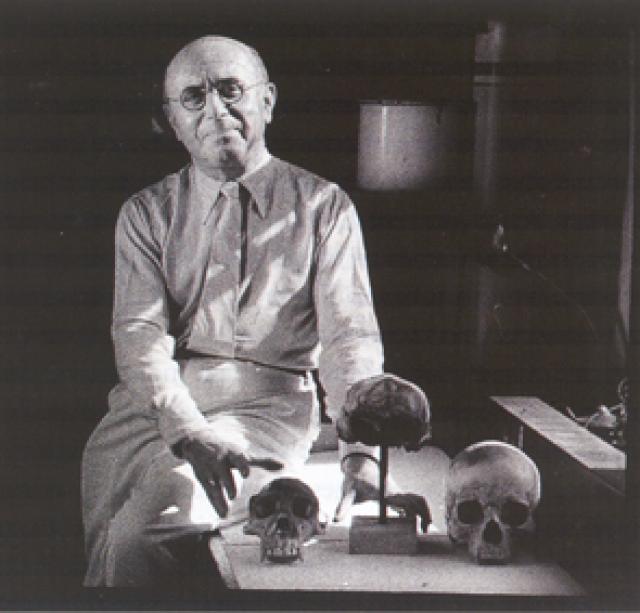
Franz Weidenreich
 Germany
Biography of Franz Weidenreich
Franz Weidenreich was a German scientist known for his expertise in physical anthropology and anatomy, particularly his research on the remains of the "Peking Man" (Sinanthropus pekinensis). He was born on June 7, 1873, in Edenkoben, Germany.
Weidenreich studied medicine at the universities of Munich, Kiel, Berlin, and Strasbourg, where he obtained his medical degree in 1899. Initially, he primarily worked in the field of hematology. As a professor of anatomy in Strasbourg from 1904 to 1918, he published over 50 papers on anatomy. He later held the positions of chair of anatomy at Heidelberg University from 1921 to 1928 and chair of anthropology at Frankfurt University from 1928 to 1935.
His first study on human fossil remains, published in 1926, focused on the Neanderthaloid skull from Eringsdorf. In 1935, as an invited professor at the Peking Union Medical College, Weidenreich began his fundamental research on the remains of the "Peking Man," Sinanthropus pekinensis. Prior to their discovery in 1927, only fragments of cranial remains from a human-like creature from Java, Homo erectus, were known to science. Sinanthropus shared many cranial features and tooth morphology with Homo erectus. Together, these two groups of human remains, dating back to the early Middle Pleistocene epoch (approximately 1 million years ago), provided a relatively clear portrait of early humans as a distinct zoological group. Weidenreich later coined the term "archanthropus" to describe this stage.
In 1937, Weidenreich expanded his research by joining Dutch anthropologist G. H. R. von Koenigswald in Java, where they discovered new archanthropus remains. In 1938, they announced a significant finding, a large cranium of a fossil human known as Pithecanthropus robustus. In 1939, Weidenreich published a report on three Homo sapiens skulls found in the upper layer of the Zhoukoudian Cave. In 1940, he left Beijing and moved to the United States, bringing carefully crafted plaster casts of the Sinanthropus findings (the originals of these remains were lost).
In 1941, Weidenreich began working at the American Museum of Natural History in New York, devoting his final years to writing a monograph titled "The Skull of Sinanthropus pekinensis" (1943) and more than 30 articles. Additionally, he continued to develop his ideas on human evolution, which are most extensively presented in his book "Apes, Giants and Man" (1946).





