Frederick Sanger
 Great Britain
Biography of Frederick Sanger
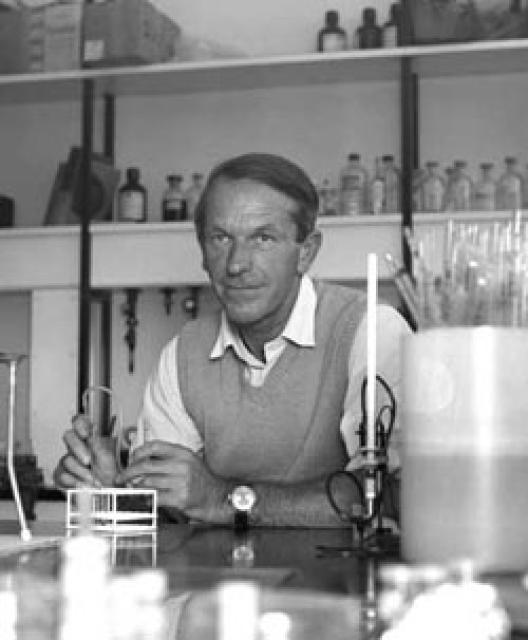
Frederick Sanger, a British biochemist, is the only scientist to have been awarded the Nobel Prize in Chemistry twice. He was born on August 13, 1918, in Rendcombe, Gloucestershire, United Kingdom, into a well-off Quaker family. His father, Frederick Sanger, was a doctor, and his mother was the daughter of a textile magnate.
Sanger attended Bryanston School in Blandford, Dorset, from 1932 to 1936, and then went on to study at St John's College, Cambridge University in 1936. It was during his time at Cambridge that Sanger became interested in biochemistry. He saw it as a path towards a deeper understanding of living matter and a way to develop a more scientific basis for solving medical problems.
In 1939, Sanger obtained a Bachelor of Science degree in Natural Sciences from Cambridge University. That same year, World War II broke out, but as a Quaker, he was exempted from military service and allowed to continue his research at Cambridge as a graduate student. In 1943, he earned his Ph.D. and joined the research group led by Albert Charles Chibnall, who had succeeded Frederick Gowland Hopkins as the professor. The research in Chibnall's lab focused mainly on insulin, and it was there that Sanger began his work on the protein.
Sanger's initial studies on insulin revealed that it contained two different N-terminal amino acids, indicating that each insulin molecule consisted of two different polypeptide chains linked together by disulfide bridges. In 1949, Sanger developed a method to break these disulfide bridges, allowing for the separation and identification of the two chains. Together with Hans Tuppy, a scientist from Vienna, Sanger devised a plan to determine the sequence of amino acids in each chain and subsequently the entire polypeptide sequence of insulin. They used enzymes to cleave the chains into smaller segments and compared them to decode the complete sequence. By 1955, Sanger had determined the entire structure of the insulin molecule, which was the first detailed analysis of a protein molecule consisting of two chains linked by disulfide bridges. For this groundbreaking work, Sanger was awarded the Nobel Prize in Chemistry in 1958.
In addition to his work on protein structures, Sanger became interested in genetics, partly influenced by his friendship with Francis Crick, who later won the Nobel Prize in Physiology or Medicine. In 1973, Sanger developed a method for determining the nucleotide sequence in DNA. His approach involved breaking the double-stranded DNA into single strands and then grouping them into four separate samples. Each sample would be restored to its original sequence using a template strand. However, the synthesis process would halt at different nucleotides in each sample, either due to limiting concentrations of specific nucleotides or the addition of a chemical that prevented further synthesis. By comparing the different-length fragments obtained from each sample through electrophoresis, the original nucleotide sequence of the DNA could be read. This method, known as Sanger sequencing, revolutionized DNA sequencing and contributed to the understanding of genetics.
In 1977, Sanger and his colleagues demonstrated the effectiveness of their sequencing method by determining the sequence of 5,375 nucleotides in the DNA of a bacterial virus. This was the first comprehensive decoding of DNA sequence. The complete list of these nucleotide sequences for the DNA of phage Phi X174 was published in the journal "Nature." For his contributions to the field of nucleic acids, Sanger, along with Walter Gilbert, received half of the Nobel Prize in Chemistry in 1980. The other half was awarded to Paul Berg. This made Sanger the only person to have received two Nobel Prizes in Chemistry.
Sanger retired from his position at the Medical Research Council in 1983. A modest and private individual, he enjoyed sailing and working in his garden during his leisure time.