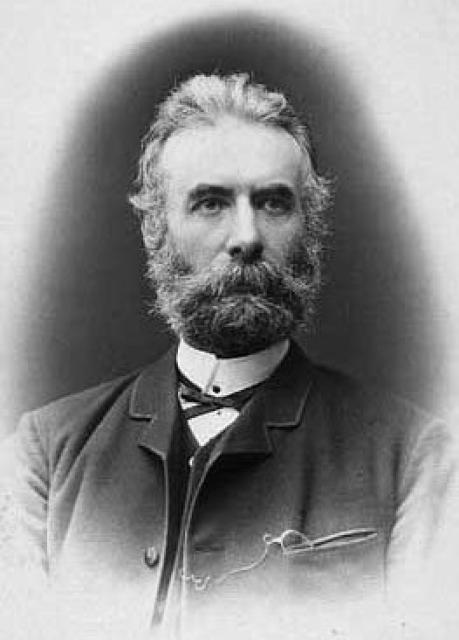
Frederik Bajer
 Denmark
- Early Life and Military Career
- Witness to the Horrors of War
- Pacifism and Political Activism
- International Peace Advocacy
- Nobel Peace Prize and Later Years
Early Life and Military Career
Frederik Bajer, a Danish author and politician known for his advocacy for peace, was born on 21 April 1837, in Vester Egede, to a clergyman father, Alfred Beyer. In 1865, he changed his surname from Beyer to Bajer. At the age of 11, he enrolled in the Sorø Academy boarding school. Despite his admission of being a lazy student, Bajer developed a keen interest in military history and Napoleon Bonaparte.
In 1854, he joined the National Cadet Corps in Copenhagen and was commissioned as a cavalry lieutenant two years later. He served in the Danish army from 1856 to 1864, during which time he attended further military training. Concurrent with his military career, Bajer pursued his academic interests, writing articles on education and studying French, Norwegian, and Swedish.
Witness to the Horrors of War
The Second Schleswig War (1864) between Denmark and Prussia shattered Bajer's romantic view of the military profession. Witnessing the brutality of war firsthand, he experienced a profound shift in perspective. After the war, the Danish military underwent downsizing, forcing Bajer to postpone his marriage to Mathilde Schlüter.
Pacifism and Political Activism
In the aftermath of the war, Bajer embarked on a new path. He began teaching and writing newspaper articles, while his pacifist beliefs continued to evolve. Inspired by the writings of Frédéric Passy, he attempted to establish a Danish peace society in 1867 but faced opposition from those who struggled to reconcile with Denmark's defeat.
Undeterred, Bajer promoted the idea that replacing monarchies with republics would foster peace in Scandinavia. In 1870, he founded the Association of Scandinavian Free States, envisioning a federation of northern nations as a model for others. The following year, he co-founded the Danish Women's Association, recognizing the importance of political empowerment for women.
In 1872, Bajer entered politics, winning a seat in the Danish Parliament as a member of the Liberal Party. He served in the lower chamber until 1895, advocating for women's rights, reduced military spending, and peace.
International Peace Advocacy
In 1875, Bajer authored an article highlighting the dangers posed to Scandinavia by future European wars. He proposed an international treaty to guarantee the neutrality of the region. To pursue this goal, he established the Danish Neutrality Association (later renamed the Danish Peace Society) in 1882.
In 1889, Bajer became the only Danish attendee at the inaugural meeting of the Inter-Parliamentary Union (IPU), founded by William Randal Cremer and Frédéric Passy to promote peace through collaboration between European parliamentarians. Despite initial skepticism from his colleagues, Bajer succeeded in forming an IPU group in Denmark in 1891 and was elected to the IPU Council in 1893, representing Norway, Denmark, and Sweden.
In 1890, at the International Peace Congress in London, Bajer proposed the creation of an international bureau to facilitate communication and peaceful conflict resolution. The proposal was approved at the 3rd Congress in Rome the following year, establishing the International Peace Bureau (IPB) in Bern, Switzerland, under the leadership of Elie Ducommun. Bajer served as the first president of the IPB until 1907.
Nobel Peace Prize and Later Years
Bajer's tireless pacifist efforts gained increasing support in Denmark. In 1893, the Danish Peace Society collected over 240,000 signatures on an anti-war petition. His advocacy for arbitration yielded some success in 1904–1905, with Denmark signing treaties with Portugal, Italy, and the Netherlands.
In 1908, Bajer's dream of a Scandinavian Interparliamentary Union for regional cooperation was realized. The same year, he was awarded the Nobel Peace Prize. Illness prevented him from accepting the prize in person, but he delivered his Nobel Lecture the following May. Emphasizing the importance of international law in resolving disputes, he declared, "We must do everything in our power to make the idea of law prevail."
Throughout his later publications, Bajer continued to advocate for Denmark's strict neutrality policy, which undoubtedly influenced the country's declaration of neutrality at the outbreak of World War I. Despite the spreading conflict, Bajer remained optimistic, stating, "The cause of peace has now more work than ever."
Suffering from a debilitating illness, Bajer maintained connections between pacifists during and after the war. After his death on 22 January 1922, his wife, Mathilde, continued his legacy for many years. Throughout his life, Frederik Bajer's unwavering dedication to peace and international cooperation left an enduring impact on the world.


