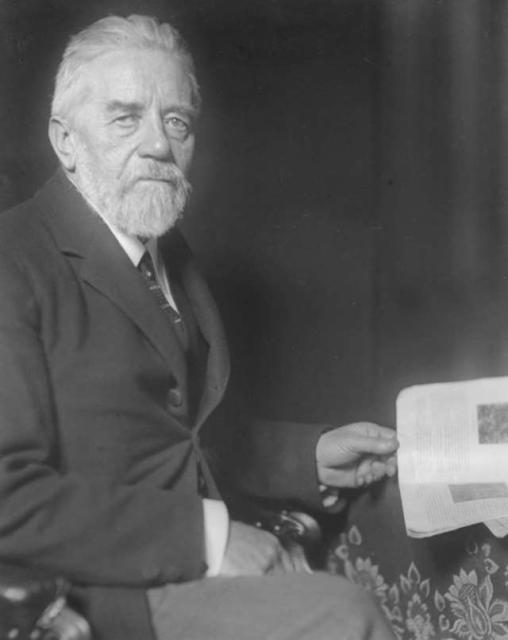
Friedrich Becke
 Austria
- Friedrich Becke: A Pioneer in Mineralogy and Petrography
- Academic and Petrographic Research
- Professorship and Academic Leadership
- Scientific Contributions
- Recognition and Legacy
Friedrich Becke: A Pioneer in Mineralogy and Petrography
Early Life and EducationFriedrich Becke was born on December 31, 1855, in Prague, Austria-Hungary. His father was a Sudeten German bookseller. Becke received his early and secondary education in Prague, Budweis (Czech Republic), and Vienna. In 1874, he enrolled at the University of Vienna, where he was influenced by the lectures of Gustav Tschermak to pursue mineralogy.
Academic and Petrographic Research
Becke's student work caught Tschermak's attention, leading to his appointment as an assistant after graduating. His first published work (1879) introduced a new polarization microscope for petrographic analysis of rocks and minerals. Becke's petrographic study of Austria's metamorphic rocks became the basis of his doctoral thesis (1882).
Professorship and Academic Leadership
In 1882, Becke began his academic career as an assistant professor at the University of Chernivtsi (Ukraine). He became a full professor of mineralogy in 1885 and served as rector from 1888 to 1890. In 1890, he was invited to join the University of Prague as a successor to V. Zepharovic. He later worked at the Charles-Ferdinand University in Prague.
In 1898, Becke emigrated to Austria, where he became a professor at the University of Vienna. He served as rector from 1918 to 1919. From 1911 to 1929, he was the general secretary of the Austrian Academy of Sciences.
Scientific Contributions
Becke is renowned for developing the Becke Line method for identifying minerals based on their optical properties. He made significant contributions to petrography, including his pioneering research on metamorphic rocks. His method of determining the refractive indices of minerals is widely used in petrographic microscopy.
Recognition and Legacy
Becke became a foreign corresponding member of the St. Petersburg Academy of Sciences in 1912. His scientific work has had a profound impact on the fields of mineralogy and petrography. He is remembered as one of the most influential scientists in these disciplines.




