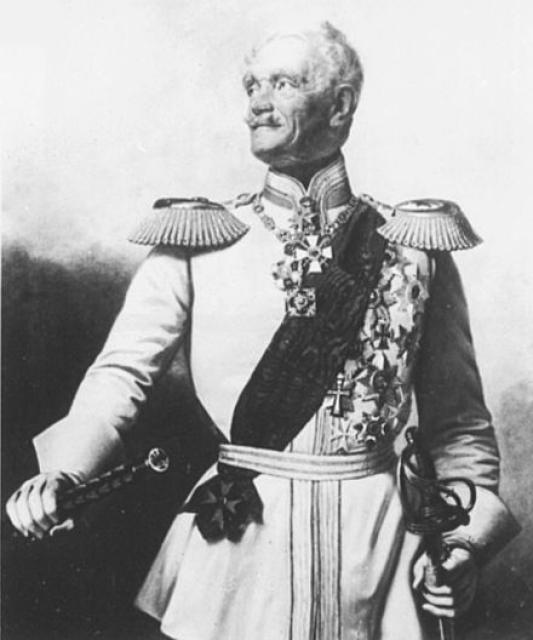
Friedrich Heinrich Ernst Wrangel
 Germany
- Early Life and Military Service
- Napoleonic Wars
- Liberation War
- High Commands
- Intervention in Denmark
- Suppression of the Berlin Uprising
- Danish War
- Later Career
Early Life and Military Service
Friedrich Heinrich Ernst von Wrangel was born into an aristocratic family of Prussian landowners and officers. At the tender age of 12, he joined the Prussian army in 1796 as a dragoon lieutenant.
Napoleonic Wars
During the Russo-Prussian-French War of 1806-1807, Wrangel saw his first combat. He was severely wounded at the Battle of Heilsberg while fighting alongside the Russian army. Despite his injury, he continued his service in the Prussian military.
Liberation War
In 1813, Wrangel gained fame for his bravery during the Liberation War against Napoleon. His outstanding performance at the battles of Hanau, Liebertwolkwitz, and Leipzig earned him promotions to major, lieutenant colonel, and colonel. He received Prussia's highest orders and became known to the king, which significantly influenced his future career.
High Commands
Wrangel commanded the 10th Cavalry Brigade in 1821 and was promoted to major general in 1823. The following year, he became a lieutenant general and commanded the 13th Cavalry Division. In 1837, he played a key role in quelling civil unrest in Münster. From 1839 to 1842, he led the 1st Army Corps in Königsberg, later taking command of the 3rd Corps in his hometown of Stettin.
Intervention in Denmark
In 1848, Prussia saw an opportunity to capitalize on an armed uprising in the German duchies of Schleswig and Holstein, which were part of the Danish kingdom. Wrangel was appointed commander-in-chief of a German coalition formed to support the rebels. He invaded the duchies and defeated the Danish forces at Schleswig, then captured the fortress of Fredericia. However, the invasion of Denmark was halted by Russia and other European powers, leading to an armistice in August 1848.
Suppression of the Berlin Uprising
During the 1848-1849 Revolution in Germany, Wrangel led troops to Berlin to quell a popular uprising. He forced the insurgents to surrender, effectively ending the rebellion.
Danish War
In 1849, Wrangel again invaded Denmark, violating the armistice. However, Prussia was once more pressured to withdraw, and the uprising in the duchies was eventually put down. Despite the setbacks, Wrangel's role in the Danish War brought him honors and the rank of general of the cavalry.
Later Career
In 1850, Wrangel was appointed governor of Berlin. Six years later, he was promoted to general field marshal of the Prussian Kingdom, marking the 60th anniversary of his military service. Wrangel died in 1877 at the age of 95.


