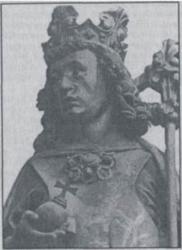
Friedrich Wilhelm I
 Germany
- Biography of Friedrich Wilhelm I of Prussia
- Early Life
- Austerity and Military Focus
- Tyrannical Rule
- Weaknesses and Eccentricities
- Legacy and Influence
Biography of Friedrich Wilhelm I of Prussia
Friedrich Wilhelm I, also known as the "Soldier King," was the King of Prussia. Although not particularly revered by the Germans themselves, he instilled a notorious sense of order among his subjects.
Early Life
Friedrich Wilhelm I was born into the Hohenzollern dynasty in 1688. He ascended to the throne in 1713 at the age of twenty-five, having been raised in a military environment and possessing well-formed views of military discipline.
Austerity and Military Focus
Friedrich Wilhelm I despised anything French and promoted frugality and simplicity at his court in contrast to the lavishness of Versailles. He canceled balls and reduced the number of courtiers and servants. He personally supervised important state affairs, cutting down on ministerial positions to save money. His policies focused on protectionist measures and the development of Prussian industries, which significantly increased annual revenue.
Tyrannical Rule
Friedrich Wilhelm I's meticulous attention to detail often bordered on absurdity, earning him ridicule throughout Europe. He frequently walked the streets of Berlin and Potsdam in the company of his entourage, using his cane to discipline idlers, regardless of their gender or age. He even punished those caught visiting taverns during inappropriate hours.
Not only did he tyrannize his subjects, but he also abused his own family. He physically assaulted his queen, princesses, and his only heir, Crown Prince Friedrich, who would later become Frederick the Great. The prince attempted to escape his father's despotic rule but was captured and placed under house arrest. The officer who had tried to aid his escape was hanged outside the prince's window as a warning.
Weaknesses and Eccentricities
Despite his ruthlessness, Friedrich Wilhelm I had two weaknesses. The first was his love for tobacco, which he indulged in gatherings known as "tobacco colleges," where smoking was compulsory. These gatherings provided an informal setting for discussions on important state matters. His second weakness was his allocation of funds to the army, which accounted for 80% of the budget. The Prussian army, known for its discipline, became the core of his reign.
Legacy and Influence
Friedrich Wilhelm I transformed Prussia into a militaristic state, where every young peasant or burgess was a potential recruit and every landlord a military commissioner. His army was well-fed, well-uniformed, and well-trained. Despite this, Prussia rarely engaged in wars during his reign.
The most significant achievement of Friedrich Wilhelm I was the establishment of the Potsdam Guards, a regiment made up of exceptionally tall soldiers. When Prussia ran out of tall men, the king's emissaries scoured Europe to find recruits. In 1739, even the renowned Russian polymath Mikhail Lomonosov briefly served in the Prussian Guards.
Friedrich Wilhelm I also contributed to medical advancements, building hospitals to tend to war casualties, and promoted the establishment of a network of public schools. His focus on cleanliness and discipline resonated with his subjects, shaping the German character and way of life that still exists today.