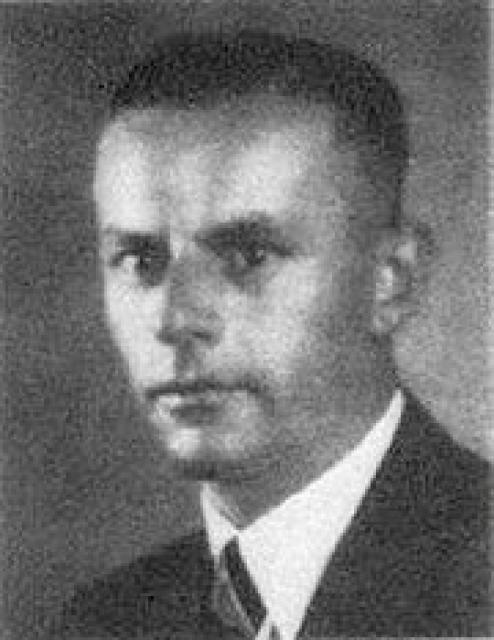
Friedrich Wilhelm Kruger
 Austria
Biography of Friedrich-Wilhelm Krüger
Friedrich-Wilhelm Krüger was a German Nazi and high-ranking member of the SA and SS. From 1939 to 1943, he served as a General in the SS troops and as the General of Police in the General Government of occupied Poland. He was known for organizing and leading numerous war crimes.
Early Life
Friedrich-Wilhelm Krüger was born on February 27, 1894, in Strasbourg, Alsace-Lorraine, which is now part of France. With only a primary education, Krüger left school to pursue a military career and became a cadet at military schools in Karlsruhe and Groß-Lichterfelde. In June 1914, Friedrich-Wilhelm received the rank of Second Lieutenant in the German army and participated in World War I. He survived three wounds and was awarded the Iron Cross 1st and 2nd Class.
After the war, Krüger joined the naval brigade and became a member of Lützow Free Corps in August 1919, leaving in March 1920. He worked as a clerk in Berlin until 1923 and then became the director of a waste incineration factory in 1924. In 1928, he left the company due to corruption suspicions and started his career as an entrepreneur. Friedrich-Wilhelm married in 1922, and together with his wife, they had two children while adopting three more.
Rise in the Nazi Party
During his time at the waste incineration factory, Krüger first met Kurt Daluege, who worked as an engineer and later became the SS commander in Berlin and the head of public order police. Kurt and Friedrich-Wilhelm became friends. In November 1929, Wilhelm joined the Nazi Party (NSDAP), followed by his membership in the SS in February 1931. In April, he suddenly found himself in the SA thanks to Daluege's influence. With Daluege's support, Krüger quickly gained access to the stormtrooper units and became the Chief of Staff of the SA "East" Group in April 1931. By November of the same year, Friedrich-Wilhelm was already serving as the commander of the SA "East" Group. In June 1932, he became an SA Gruppenführer for special assignments at Ernst Röhm's headquarters, the leader of the SA and one of the Nazi leaders.
Continuing his ascent, in June 1933, Krüger, as an Obergruppenführer of the SA, was appointed the Chief of Combat Training. He survived the "Night of the Long Knives" while many high-ranking SA members, including Ernst Röhm, were killed. In 1935, he regained all of his command positions in the SS. Krüger was appointed an Obergruppenführer in Munich and later, after discussing his career with the SS leadership and Adolf Hitler, became the Inspector of the Border Police and Hitler's personal representative at official NSDAP meetings.
Role in Occupied Poland
Due to his ambition and loyalty to Nazism, on October 4, 1939, Friedrich-Wilhelm was appointed as a General of the SS troops and the General of Police by Heinrich Himmler, delineating the boundaries of his influence as part of occupied Poland. He was responsible for suppressing uprisings in concentration camps and establishing forced labor camps. Due to a dispute with the General Governor Hans Frank, Krüger was dismissed on November 9, 1943, and replaced by Wilhelm Koppe. The Polish underground government sought to assassinate Krüger, but the attempt on April 20, 1943, failed when two bombs thrown at his car missed the target. Six months later, Friedrich-Wilhelm wrote in a letter, "I lost honor and reputation because of my 14-year struggle in the General Government."
From November 1943 to April 1944, he trained units of the 7th SS Mountain Division "Prinz Eugen" in occupied Yugoslavia. Although officially formed to suppress partisan activity in Yugoslavia, the division became notorious for its atrocities against the civilian population. From late May 1944, Krüger commanded the 6th SS Mountain Division "Nord," and from August, he led the V SS Mountain Corps. On September 20, 1944, he was awarded the Knight's Cross of the Iron Cross. On May 9, 1945, Krüger took his own life in Upper Austria.


