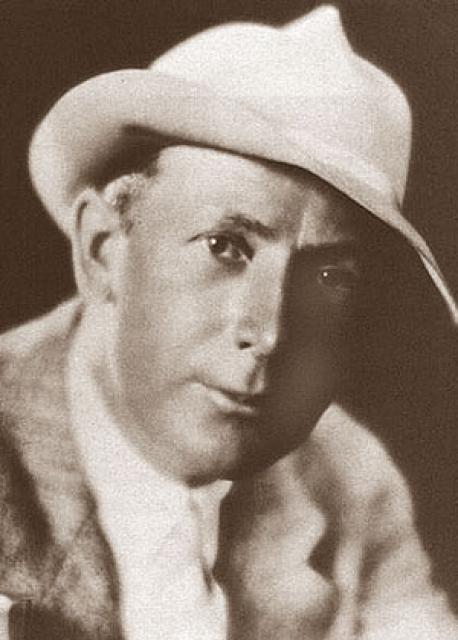
Friedrich Wilhelm Murnau
 Germany
Biography of Friedrich Wilhelm Murnau
Friedrich Wilhelm Murnau was a German film director known for his influential silent films. He was born on December 28, 1888, in Bielefeld, Westphalia. Murnau grew up in a wealthy family and had a passion for the arts from a young age. He had a toy puppet theater with lighting, a trapdoor, and straw seats. By the age of twelve, he was already familiar with the works of Schopenhauer, Ibsen, Nietzsche, Dostoevsky, and Shakespeare.
After receiving a comprehensive education at Heidelberg University and earning a doctorate in philosophy, Murnau made a drastic change in his life. In 1910, he began acting and directing plays at the renowned German Theater under the guidance of Max Reinhardt. During the war, Murnau served in the First Guard Regiment stationed in Potsdam and later joined the aviation corps. The horrors of war turned Murnau into a committed pacifist.
After the war, Murnau returned to the theater, staging plays in Zurich and Bern before venturing into the world of cinema in Berlin. His early films showcased his fascination with the mysterious and macabre, such as "The Boy in Blue" (1919), "The Head of Janus" (1920), and "The Castle of Vogelod" (1921). During this period, Murnau collaborated with renowned German screenwriter Carl Mayer, who influenced Murnau's interest in creating fantastic films. Together, they produced the masterpiece of the horror genre, "Nosferatu: A Symphony of Horror" (1922), based on Bram Stoker's novel "Dracula." The film was shot on location, using gothic architecture for the sets and featuring the enigmatic actor Max Schreck as the vampire Count Orlok.
Despite its initial success, "Nosferatu" faced legal troubles due to copyright infringement, and most copies of the film were destroyed. However, a surviving copy was discovered in 1929, ensuring the film's enduring legacy as the progenitor of vampire cinema. In the same year as "Nosferatu," Murnau directed the peasant drama "The Burning Soil" (1922), which received critical acclaim for its poetic cinematography and genuine emotions.
In 1924, Murnau released his masterpiece "The Last Laugh," which told the seemingly simple story of an aging Swiss hotel doorman. The film showcased Murnau's innovative storytelling techniques and was hailed as a cinematic poem by critics. Murnau continued his exploration of different genres, directing costume dramas such as "Tartuffe" (1925) and "Faust" (1926). However, these films were considered overly theatrical and failed to match the success of his earlier works.
Seeking new opportunities, Murnau left Germany for Hollywood, where he was offered a contract with Fox Film Corporation. In Hollywood, Murnau directed his first American film, "Sunrise: A Song of Two Humans" (1927), based on a novel by Hermann Sudermann. Despite its artistic merits, the film suffered a financial failure, which greatly impacted Murnau's career. His subsequent films in Hollywood, "4 Devils" (1929) and "City Girl" (1930), were made for financial reasons and did not receive critical acclaim.
Disillusioned with Hollywood, Murnau decided to pursue his passion for travel and documentary filmmaking. He embarked on a journey to the South Seas to create artistic documentaries. Murnau's last film, "Tabu: A Story of the South Seas" (1931), co-directed with renowned documentarian Robert Flaherty, depicted a romantic story set on a paradise island. Tragically, Murnau's life came to an end when he died in a car accident on March 11, 1931, in Los Angeles. Rumors circulated about the circumstances of his death, tarnishing his reputation. Only a handful of people attended his funeral.
Friedrich Wilhelm Murnau's innovative filmmaking techniques and artistic vision have left an indelible mark on the history of cinema. His films, such as "Nosferatu" and "The Last Laugh," continue to be celebrated for their visual storytelling and haunting atmospheres, ensuring Murnau's place as one of the pioneering figures in the silent film era.


