Fuxi
- A legendary sovereign
- The eight trigrams and the natural world
- Teacher of practical arts
- Fuxi and Nüwa
- Cultural legacy
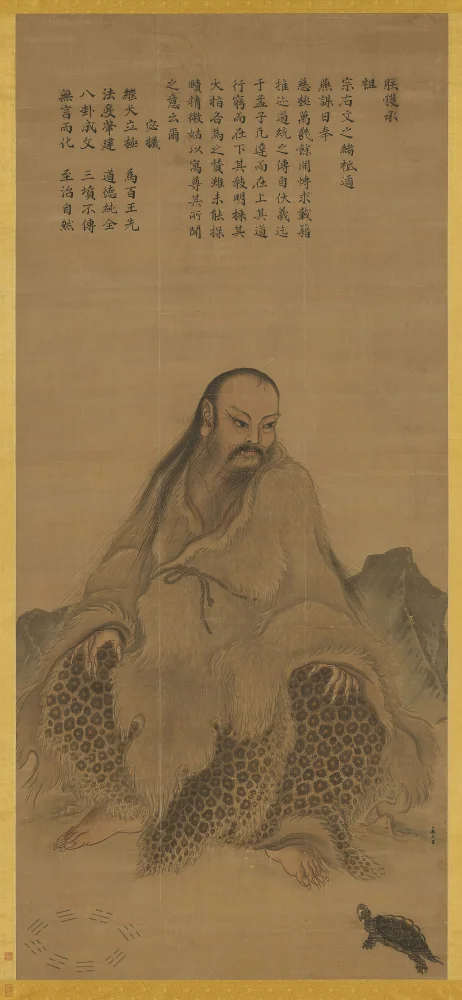
Fuxi stands at the legendary beginning of Chinese civilization, a culture hero credited with turning observations of the natural world into knowledge people could use. Tradition remembers him as the inventor of the eight trigrams, a teacher of fishing and hunting, and a founder of social customs. His story is not a recoverable historical biography; it is a set of myths through which generations explained the origins of culture, order, and human society.
A legendary sovereign
Fuxi, also written Fu Xi or Fu Hsi, is counted in many later traditions among the Three Sovereigns, a group of primordial rulers associated with the beginnings of Chinese civilization. Accounts place him in a remote age before reliable written history, so dates, reign lengths, and details of his life vary or cannot be established.
His identity also shifts across traditions. He may appear as a culture-bearing ruler, an ancestral figure, or a being with divine qualities. Later images often show him with a human upper body and a serpent or dragon-like lower body, frequently paired with Nüwa. The two are described in some accounts as siblings, in others as husband and wife, and in still others as creators or ancestors of humanity. These variations reflect the layered development of Chinese myth rather than a single fixed biography.
The eight trigrams and the natural world
Fuxi’s most enduring intellectual achievement is his traditional association with the *bagua*, the eight trigrams. Each trigram is made of three solid or broken lines, and together they express patterns of change in the natural world. In later tradition, the trigrams became central to the *Yijing*, or *Book of Changes*, a classic used for divination and philosophical reflection.
A well-known account says that Fuxi observed the patterns of heaven and earth, the movements of animals, and the features of his own body before drawing the trigrams. Another version tells of a dragon-horse emerging from a river with a pattern that inspired him. Such stories present the trigrams as a bridge between careful observation and cosmic order: human beings could read the world by discerning its recurring patterns.
The attribution is legendary and developed over time. It does not mean that a historical individual can be shown to have invented the system in one moment. Instead, Fuxi became the traditional figure through whom Chinese accounts connected early knowledge of the *Yijing* to a foundational sage.
Teacher of practical arts
Stories about Fuxi credit him with teaching people to make nets and catch fish and game. He is also associated with animal husbandry, cooking, and the establishment of marriage customs. Other traditions assign him the invention of music or early systems of writing and record-keeping.
These attributions cast civilization as a gradual transformation of everyday life. Nets, food preparation, and the keeping of animals represent practical skills; marriage rules and social organization make community possible; the trigrams offer a way to interpret the broader order of nature. Later storytellers gathered these innovations around a single exemplary figure, making Fuxi a symbol of human ingenuity and social beginnings.
Fuxi and Nüwa
Fuxi is often remembered alongside Nüwa, one of the most important creator figures in Chinese mythology. In later stories, the pair are linked with the survival or creation of humankind after a catastrophe. Their intertwined serpent bodies in art can symbolize their complementary roles and their connection to the ordering of the world.
The relationship between them was not presented identically in every period or source. Some traditions describe them as brother and sister who became the ancestors of humanity; others emphasize their partnership as a primordial couple. The pairing gave mythic form to ideas about human origins, kinship, and the balance of complementary forces.
Cultural legacy
Fuxi’s image has endured in literature, ritual, art, and accounts of China’s cultural origins. His association with the *bagua* made him especially important to traditions that connect the patterns of the cosmos with human conduct and decision-making. As one of the Three Sovereigns, he also provided a model of the sage ruler who brings practical knowledge and social order to the people.
The stories about him are best read as cultural memory rather than a documented record of one person’s life. Their continuing appeal lies in the portrait they offer: a founder who looks closely at the world, finds patterns in it, and turns those insights into tools, customs, and shared meaning.