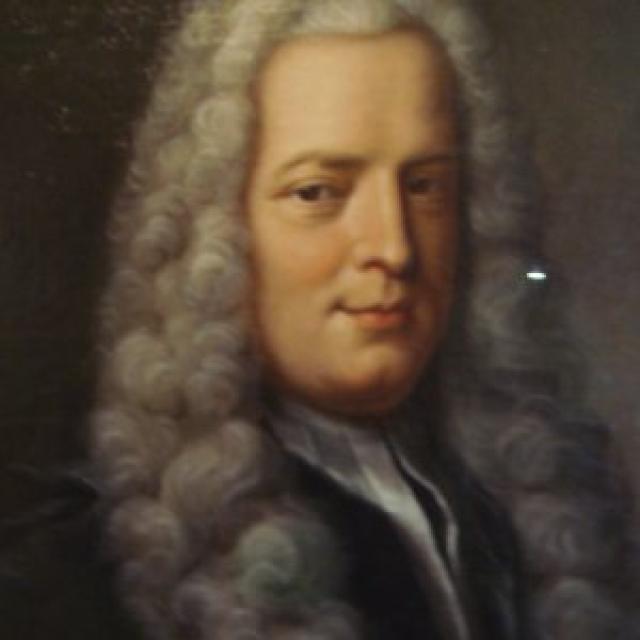
Gabriel Cramer
 Switzerland
Biography of Gabriel Cramer
Gabriel Cramer was a Swiss mathematician, a student and friend of Johann Bernoulli, and one of the creators of linear algebra.
Early Life and Education
Gabriel Cramer was born into a family of a French-speaking doctor. From an early age, he showed great abilities in the field of mathematics. At the age of 18, he defended his dissertation and at 20, Cramer applied for a vacant position as a philosophy professor at the University of Geneva. There were three candidates, all of whom made a good impression, and the magistrates made the decision to establish a separate mathematics department and send two "extra" candidates, including Cramer, to travel at their own expense.
Travels and Correspondence
In 1727, Cramer took advantage of this opportunity and traveled around Europe for two years, learning from leading mathematicians such as Johann Bernoulli and Euler in Basel, Galley and De Moivre in London, Montmort and Clairaut in Paris, and others. Upon his return, he continued to correspond with them throughout his short life.
Contributions and Publications
In 1728, Cramer found a solution to the St. Petersburg paradox, which was similar to the one published by Daniel Bernoulli ten years later. In 1729, he returned to Geneva and resumed his teaching work. In his free time, Cramer wrote numerous articles on various topics, including geometry, the history of mathematics, philosophy, and applications of probability theory. He also published a work on celestial mechanics in 1730 and a commentary on Newton's classification of third-order curves in 1746.
Collaboration with Johann Bernoulli and Jacob Bernoulli
Around 1740, Johann Bernoulli entrusted Cramer with the task of publishing a collection of his works. In 1742, Cramer published a four-volume collection, and soon after (1744), he released a similar posthumous collection of works by his brother Jacob Bernoulli and a two-volume correspondence between Leibniz and Johann Bernoulli. These publications had a significant impact on the scientific community.
Later Life and Legacy
In 1747, Cramer made a second trip to Paris and met D'Alembert. In 1751, he suffered a serious injury in a carriage accident. A doctor recommended that he rest at a French resort, but his condition worsened, and on January 4, 1752, Cramer passed away. One of his most famous works, published shortly before his death, was the treatise "Introduction à l'analyse des lignes courbes algébriques" (1750), in which he proved that an algebraic curve of the nth order is fully determined if its n(n + 3)/2 points are given. He constructed a system of linear equations to solve the problem, which became known as Cramer's method.
Cramer's methods quickly gained further development in the works of Bezout, Vandermonde, and Cayley, who completed the foundations of linear algebra. The theory of determinants found numerous applications in astronomy, mechanics (centuries-old equation), solving algebraic systems, and the study of forms.
It is interesting to note that throughout his extensive research on curves, Cramer never used mathematical analysis, although he undoubtedly had a command of those methods.