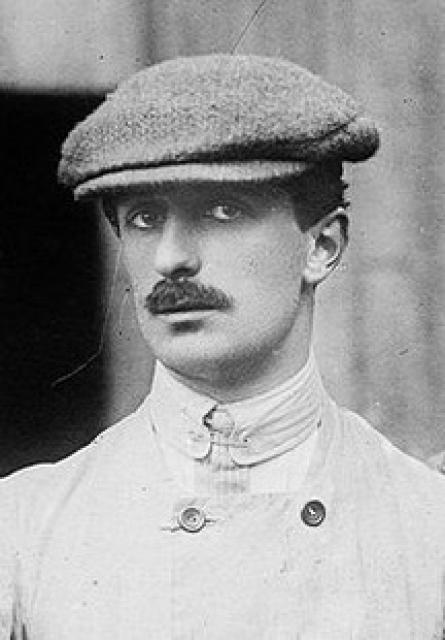
Gabriel Voisin
 France
- Pioneer of Aviation and Automotive Genius
- Aviation Experiments and Breakthroughs
- Serial Production and Military Success
- Transition to Automotive Design
- Innovations and Market Challenges
- Bankruptcy and Legacy
- Awards and Accolades
Pioneer of Aviation and Automotive Genius
Early Life and EducationGabriel Voisin, a French aviation pioneer, aircraft and automobile designer, and entrepreneur, was born into a family shadowed by his father's abandonment. Raised by his mother and grandfather, a factory owner in Neuville, he excelled in both art education at the Lyon School of Fine Arts and engineering studies in Paris.
Aviation Experiments and Breakthroughs
Voisin's fascination with aviation began in 1900 when he encountered Clement Ader. From 1904, the Voisin brothers, alongside Louis Blériot, experimented with floatplane gliders on the Seine River. Their endeavors were subsidized by Ernest Archdeacon, the founder of the French Aero Club. However, in 1905, a near-drowning incident highlighted the dangers of their flight attempts.
From 1906 to 1907, the Voisins constructed and successfully tested the first European aircraft capable of true flight. Charles Voisin made the maiden flight on a machine designed by Gabriel, featuring a biplane configuration with a pusher propeller and foreplanes for pitch control. This aircraft paved the way for the establishment of the Voisin Frères company in 1906.
In 1908, Henri Farman demonstrated the aircraft's maneuverability by completing a closed kilometer-long circuit, proving its controllability. Unlike the Wright brothers' aircraft, which required a catapult for takeoff, the Voisin biplane's wheeled design enabled independent takeoffs.
Serial Production and Military Success
Henri Farman played a pivotal role in popularizing the Voisin aircraft and improving its design, including the incorporation of ailerons. In 1910, the Canard Voisin, the first mass-produced canard configuration aircraft, took flight. Equipped with floats by Henri Fabre, the Voisin became the first seaplane, later adopted by the French Navy as the world's first ship-based aircraft on the floating dock, "Foudre."
The Voisin III, introduced in 1914, was a two-seater, single-engine bomber-reconnaissance aircraft capable of carrying up to 150 kg of bombs in addition to a machine gun. The Voisin III formed the foundation of France's first dedicated bombing squadrons and claimed the first French aerial victory in World War I. In 1915, a squadron of 18 Voisin aircraft raided the chemical gas plant in Ludwigshafen, Germany.
During the war, approximately 800 Voisin III aircraft were produced in France, and around 300 Voisin V models were built. The Russian Air Force also employed Voisin aircraft, manufactured by Lebedyev, Anatra, and Dux.
Transition to Automotive Design
Haunted by the destructive capabilities of aircraft, Voisin sought a new path after the war and turned to automobile design. In 1919, he established an automobile engine factory in his former aircraft plant and began designing car bodies. Combining his engineering expertise from aviation and artistic background, Voisin employed aluminum alloys to create lightweight and aesthetically pleasing vehicles, albeit expensive to produce. Notable collaborators included designer André Talmon and engineer André Lefebvre, who later became the chief designer at Citroën.
Innovations and Market Challenges
In 1923, Voisin created the first racing car with a monocoque chassis. His cars remained relatively compact until around 1930, when he designed a 5-liter, 12-cylinder engine, transitioning the company into the luxury automobile segment. However, the Great Depression precipitated a market decline that adversely affected Voisin's firm. Lefebvre moved to Renault, and Talmon left due to creative differences. Despite the introduction of a 12-cylinder engine, Voisin's 30s models relied on six-cylinder Knight engines.
In 1934, no longer constrained by partners' opinions, Voisin revisited the sleek art deco designs, introducing low, "aerodynamic" vehicles, even more exclusive and expensive than before. The Voisin C28 surpassed the Bugatti 57 in price by a quarter. Nonetheless, Voisin managed to maintain a lightweight chassis, weighing only 1150 kg despite its 4.8 m length and 3 m wheelbase.
Bankruptcy and Legacy
By 1938, Avions Voisin had declared bankruptcy. The final Voisin chassis, the C28 with a Knight engine, was produced from 1935 to 1937 with a production run of 61 units. The most luxurious variant, the Voisin C28 Saliot Cabriolet, reportedly had only two units produced, with one surviving in the United States today.
Post-World War II, Voisin designed an ultra-compact, low-cost vehicle with a 200cc single-cylinder engine, known as the Biscuter. The vehicle was mass-produced in Francoist Spain with a production run of over 12,000 units. Voisin retired from active work in 1960.
Awards and Accolades
Gabriel Voisin's contributions to aviation and automotive design were recognized through various accolades, including the Grand Gold Medal of the SEP (1948). His legacy as a pioneer and innovator continues to inspire generations of engineers and designers.


