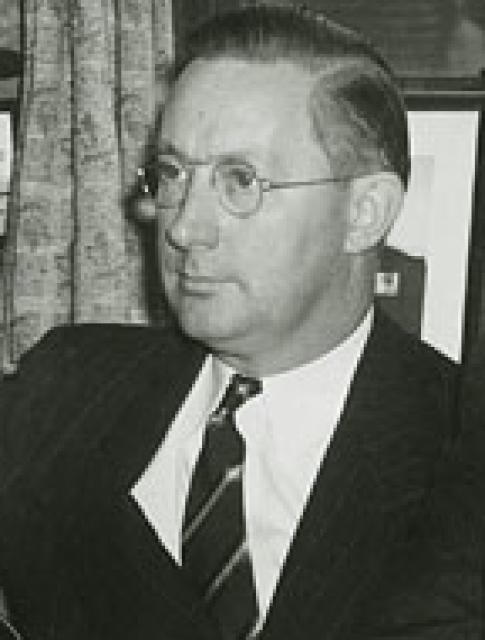
Don Berlin
 USA
USABiography of Don Berlin
Donovan Reece Berlin, an American military aircraft designer, is best known for his contributions to the development of military aviation. He was born in Romona, Indiana and spent his formative years in Brook, IN. In 1921, Berlin earned a bachelor's degree in mechanical engineering from Purdue University. He was responsible for early testing of the aerodynamic tube for the US Air Corps at McCook Field in Dayton, Ohio.
With his knowledge in aeronautics, Berlin became a project engineer and chief draftsman at Douglas Aircraft in early 1926. In 1929, he joined Northrop Corporation, where he worked on the development of the monoplanes Northrop Alpha and Northrop Gamma, as well as the single-engine aircraft Northrop Delta. Due to disagreements with Jack Northrop over the wing design of a new fighter, Berlin found himself unemployed.
In 1934, Berlin began his long career at Curtiss-Wright Corporation. Impressed by his previous work, company president Ralph Damon quickly promoted Berlin to the position of chief engineer. It was during his time at Curtiss-Wright that Berlin became a project engineer for the development of a new fighter, known as the Model 75. After the initial prototype lost the competition to the Seversky P-35, Berlin made modifications to the design, resulting in the P-36 Hawk. The P-36 Hawk became a leading fighter in the late 1930s and was widely used in various countries, including France and Finland.
Berlin continued to improve the P-36, equipping it with a more powerful Allison V-12 engine and making other design changes. These modifications led to the development of experimental models such as the XP-37/YP-37 and XP-42, until the XP-40 model became the most successful. The XP-40 won the competition held by the US Air Corps in 1939 and went on to be produced as the P-40 Warhawk, with over 13,000 units manufactured.
During World War II, Berlin remained the chief engineer and designer at Curtiss-Wright. He worked on various experimental programs, including the XP-55 Ascender interceptor, and the Curtiss SO3C Seamew seaplane, which was adopted by the US Navy. Berlin also oversaw the construction of the carrier-based dive-bomber Curtiss SB2C Helldiver. In 1942, disappointed by the lack of support for further development of the P-40, Berlin left Curtiss-Wright and joined the engineering department at General Motors in Detroit. He designed the unsuccessful Fisher P-75 Eagle escort fighter, using components from existing aircraft.
In 1947, Berlin joined McDonnell Aircraft as an executive vice president, overseeing several significant projects, including the McDonnell F3H Demon for the US Navy and the McDonnell XF-85 Goblin and XF-88 Voodoo for the US Air Force. In 1953, he was named president and director of Piasecki Helicopter Corporation. His tenure was controversial, particularly due to his decision to remove Frank Piasecki, the company's founder and chairman of the board, from his position. Berlin's support from the majority of shareholders led to the company's name change to Vertol Helicopter in 1956.
As head of engineering at Vertol, Berlin successfully developed the military transport helicopter Piasecki H-21, which initially faced challenges. His support for the development of new helicopter designs for both commercial and military markets led to the success of the Vertol Model 107 (Boeing CH-47 Chinook), which won the US Army competition in September 1958.
Berlin returned to Curtiss-Wright in 1963 and ended his aviation career at the E.F. Felt Company, a manufacturer of aircraft components. After a prolonged illness, Don Berlin passed away at the age of 84 on May 17, 1982. The Flying Tigers Foundation named him an honorary member, recognizing his contributions to aviation.


