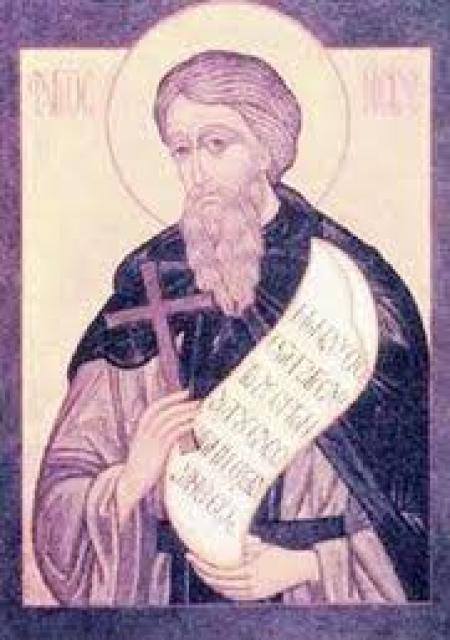
Gaius Marius Victorinus
 Italy
Italy- Marius Victorinus: A Neoplatonist Philosopher and Christian Apologist
- Successful Orator and Senator
- Conversion to Christianity
- Upholding the Faith under Imperial Pressure
- Victorinus' Resignation and Apologetics
- Biblical Commentary and Influence on Augustine
- Influence on Augustine and Neoplatonism
- Treatises on Rhetoric and Grammar
- Christian Doctrine and Trinitarian Thought
Marius Victorinus: A Neoplatonist Philosopher and Christian Apologist
Early Life and EducationMarius Victorinus, a native of Africa, received his education in his homeland, specializing in rhetoric. Around 340 AD, he travelled to Rome (earning the moniker "Africanus") likely to teach oratory.
Successful Orator and Senator
Victorinus enjoyed a successful oratorical career, eventually securing a minor position in the Senate. His career flourished under Emperor Constantius II. In 354 AD, he received a prestigious statue on the Trajan Forum.
Conversion to Christianity
Victorinus' conversion from Platonism to Christianity (baptized in 355 AD) had a profound impact on Augustine of Hippo, as recounted in Book 8 of his Confessions. His conversion marked a significant historical turning point, foreshadowing the growing abandonment of paganism among intellectuals. Despite allegations of a rationalist conversion, subsequent events such as the attempted pagan revival under Julian the Apostate suggest Victorinus' Christianity was genuine.
Upholding the Faith under Imperial Pressure
Emperor Julian's Pagan RevivalJulian the Apostate, raised in Christianity, later reverted to paganism and attempted to restore it as the dominant religion. Seeking to suppress Christian teachers, the emperor decreed in 362 AD that all state-approved professors must be approved by municipal councils.
Victorinus' Resignation and Apologetics
Victorinus surrendered his official position as "rhetor of the City of Rome" but not his oratorical skills. The elderly professor vigorously penned scholarly treatises on the Trinity, defending the Nicene Creed's assertion that God the Son is "of one substance" (consubstantialis) with the Father.
Biblical Commentary and Influence on Augustine
Latin Commentaries on Pauline EpistlesVictorinus authored the first Latin commentaries on Paul's Epistles. While mentions exist of commentaries on Romans and Corinthians, only those on Galatians, Ephesians, and Philippians (the latter missing its first 16 lines) survive.
Influence on Augustine and Neoplatonism
Victorinus' pre-Christian writings, which mostly survive as translations, played a significant role in Augustine's synthesis of Christianity and Neoplatonism. His philosophical commentaries influenced Augustine and Boethius, despite Boethius' later criticism of their "irrationality."
Treatises on Rhetoric and Grammar
'De Definitionibus' and 'Ars Grammatica'Victorinus wrote a concise treatise on definitions ('De Definitionibus') and a grammar textbook ('Ars Grammatica'). He also discussed metrical theory in several works, some of which are now considered anonymous.
Christian Doctrine and Trinitarian Thought
Original Trinitarian ConceptVictorinus developed a novel concept of the Trinity in Christian philosophy. The sources of his ideas are debated, but Pierre Hadot's "Porphyry and Victorinus" provides a detailed analysis of their relationship.




