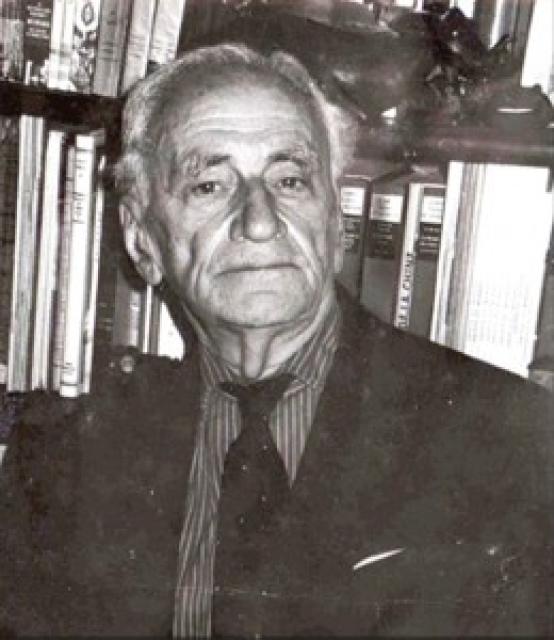
Grigoriy Kolpakchi
- Grigory Kolpakchi: A Polyglot Philosopher and Egyptologist
- Education and Career
- Participation in Anthroposophy
- Linguistic Expertise
- Egyptological Contributions
Grigory Kolpakchi: A Polyglot Philosopher and Egyptologist
Early Life and FamilyGrigory Kolpakchi, a Russian-French philosopher and Egyptologist, was born into a Jewish family in 1886 in Kharkov, Ukraine. His father, a physician, had emigrated from Bessarabia, and his mother was from Berlin. Kolpakchi's grandfather was a merchant and co-owner of a brewery in Khotin.
Education and Career
After attending gymnasium in Kharkov, Kolpakchi studied law at the University of Saint Petersburg. In 1911, he worked as an assistant attorney in the city. Alongside his legal career, he pursued his passion for art, experimenting with abstract caricature.
In 1915, Kolpakchi began his studies in Egyptology at the Practical School of Higher Studies in Paris. He also studied at the National Institute of Eastern Languages and Cultures, ultimately earning a doctorate in philosophy.
Participation in Anthroposophy
Kolpakchi became a follower of Rudolf Steiner's Anthroposophical movement in 1910. He was an active member of the Russian Anthroposophical Society and participated in the construction of the Goetheanum temple in Dornach, Switzerland.
From 1917, Kolpakchi resided in Paris, where he joined the Russian Anthroposophical Circle and became the secretary of the Masonic lodge "Hermes." He also taught at Steiner's school and published extensively in Anthroposophical and philosophical journals.
Linguistic Expertise
Kolpakchi was renowned for his extraordinary linguistic abilities. According to Soviet sources, he mastered numerous ancient and modern languages, including Russian, French, Spanish, Portuguese, Norwegian, Turkish, Serbian, Greek, Berber, and Bantu. He could read without a dictionary in various European languages as well as Latin, Ancient Greek, Chinese, Finnish, Japanese, Persian, Arabic, Ancient Assyrian, and Ancient Egyptian.
Egyptological Contributions
Kolpakchi's most significant contribution to Egyptology was his translation of the "Egyptian Book of the Dead" into German and French. Published in 1954, it became widely acclaimed and has been translated into Italian. However, some scholars, such as Jacques Vandier and Erik Hornung, criticized Kolpakchi's translation for its esoteric interpretations and lack of accuracy.



