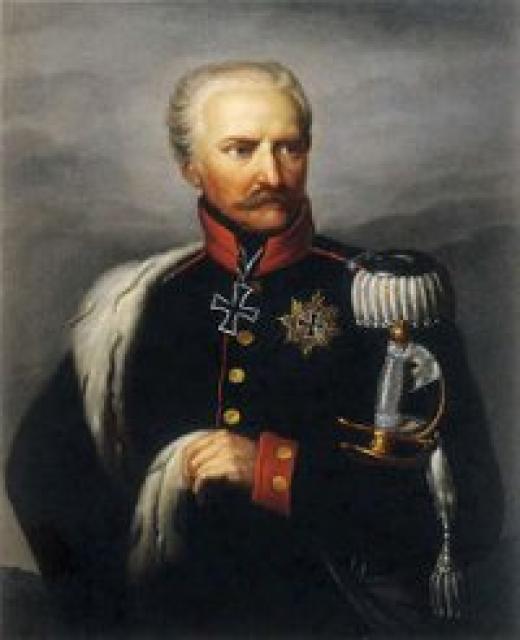
Gebhard Leberecht Blucher
 Germany
- Prussian Field Marshal Gebhard Leberecht von Blücher
- Military Service
- Napoleonic Wars
- Battle of Waterloo
- Later Years and Legacy
Prussian Field Marshal Gebhard Leberecht von Blücher
Early Life and CareerGebhard Leberecht von Blücher was born on December 16, 1742, in Rangsdorf, near Rostock. Despite his parents' objections, he enlisted in the Swedish army in 1756. During the Seven Years' War (1756-1763), he fought as a hussar against Prussia and was eventually captured. In 1760, he was persuaded to defect to Prussian service by General von Bellings.
Military Service
After serving in the Prussian army for several years, Blücher resigned in 1773. He returned to active duty in 1788, following the death of King Frederick the Great.
Despite a lack of formal education, Blücher possessed natural military talents, including sound judgment, unwavering determination, and exceptional energy. He participated in the campaign in the Netherlands and was awarded the Prussian Order of Merit in 1789. He was promoted to Lieutenant General in 1801.
Napoleonic Wars
During the disastrous Prussian campaign of 1806, Blücher escaped capture with a handful of soldiers and retreated to Lübeck. After fierce fighting, he was forced to surrender, but not before demonstrating his military prowess.
After the fall of Napoleon in 1812, Blücher, now 70 years old, became a leader of the national resistance movement in Germany. In 1813, he was given command of the combined Russo-Prussian forces in Silesia, achieving notable victories at Katzbach and Wartenburg.
Blücher played a key role in the Battle of Leipzig in 1813, where he received the rank of Field Marshal. In 1814, he led the Silesian Army in the French campaign, facing setbacks but also achieving victories at La Rothière and Montmartre.
Battle of Waterloo
In 1815, after Napoleon's return from Elba, Blücher was placed in command of the Prussian-Saxon forces in the Netherlands. Despite being defeated at Ligny and Saint-Amand, Blücher arrived at Waterloo in time to support Wellington's forces. His timely intervention helped secure the Allied victory.
Later Years and Legacy
After the war, Blücher retired to his Silesian estate, where he lived until his death in 1819. He was known for his unwavering bravery and inspiring leadership. Russian soldiers called him "Field Marshal Forwards" for his constant exhortation to advance ("Vorwärts"). Napoleon referred to him as the "old devil."
Blücher remains an iconic figure in Prussian military history, admired for his determination, audacity, and decisive actions that played a pivotal role in the defeat of Napoleon.