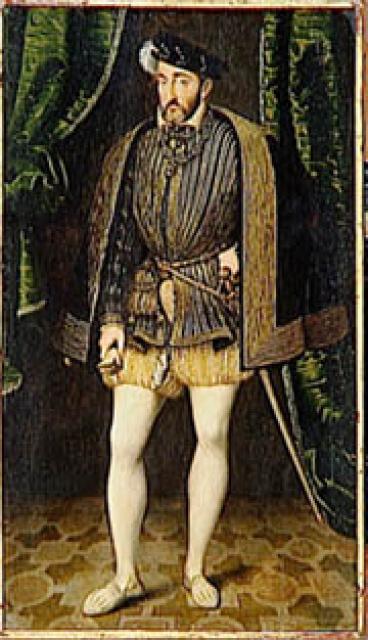
Genrich 2
 France
Biography of Henry II of France
Henry II of France, from the Valois dynasty, was the King of France from 1547. He was married to Catherine de' Medici in 1533 and was heavily influenced by Anne de Montmorency, particularly in the field of foreign policy. Henry II cruelly persecuted the Huguenots, establishing the "Court of the Burning Chamber" in 1547 to try them, and in 1559 he issued an edict demanding the death penalty for heretics. He led a struggle against Emperor Charles V in alliance with German Protestant princes and occupied the bishoprics of Metz, Toul, and Verdun in 1552. In 1558, he reclaimed Calais from the English. He signed the Peace of Cateau-Cambrésis in 1559, which ended the Italian Wars. Henry II was fatally wounded in a tournament.
Born in 1519, Henry was the middle of three sons of King Francis I and, therefore, was not the heir to the throne. The formative years of his character were spent in Spain with his elder brother as hostages to facilitate their father's return to France after being taken captive by the Holy Roman Emperor following the Battle of Pavia in 1525. During most of this time, both royal sons were kept in unfavorable and even humiliating conditions in numerous Castilian fortresses, as the Spaniards sought to prevent any escape or rescue attempts. Henry never forgot the humiliation associated with this captivity and developed an indomitable hatred for Charles V, the initiator of his imprisonment.
A few years after returning to France, Henry married Catherine de' Medici, daughter of the Duke of Urbino Lorenzo de' Medici and his wife Madeleine de la Tour d'Auvergne, who died when Catherine was still a child. Catherine was a relative and ward of the Pope, so the marriage was at the center of a carefully planned Franco-Papal alliance. However, the death of Pope Clement VII a few months later disrupted this plan and deprived Francis I of support in Italy. The political advantage of the marriage with Catherine disappeared, and many contemporaries, if not the spouses themselves, considered it a mistake, especially when Henry, after the sudden death of his elder brother, the Dauphin Francis, in 1536, became the first in the line of succession. By this time, Henry had already begun his relationship with Diane de Poitiers.
Diane, a widow of great beauty, who was twenty years older than Henry, remained by his side, influencing the thoughts and actions of the Dauphin and later the King. Catherine de' Medici remained in the background throughout these years, showing no signs of the remarkable political abilities that would make her the central figure of the kingdom during the reigns of her three sons. Perhaps only her unwavering support for anti-Habsburg Italian exiles, who sought refuge at the French court, brought her into contact with political affairs. Since Diane de Poitiers was intelligent enough, she demanded that her lover show respect to his wife. Catherine, highly educated but physically unattractive, may have won Henry's goodwill, if not his love. There was little that connected the Dauphin to his father. Even during the lifetime of the Dauphin Francis, Francis I showed a preference for his younger son, Charles, who resembled him in his temperament. Since Henry, as the Dauphin, began to express his own political opinions, the gap widened. This became particularly evident in Henry's attitude towards the peace treaty in Crépy, which required France to relinquish all its territorial acquisitions made from a certain point, including Savoy (including Piedmont) conquered in 1536. The treaty also promised military aid against the Turks and, in a secret clause, agreed to the calling of a general council to settle religious disputes. The treaty also included a marriage between Francis I's younger son and a representative of the House of Habsburg. The treaty implied the abandonment of France's traditional legitimate claims to Milan, as well as previous claims to the Kingdom of Naples and the counties of Asti, Flanders, and Artois. In the presence of witnesses, the Dauphin declared his opposition to this peace treaty, thus expressing his desire to preserve the integrity of the monarchy. The death of Charles of Orleans in 1545 prevented the execution of the treaty, but Henry continued to distance himself from his father and his policies. Above all, he maintained contact with German Protestants and gave them certain hopes of introducing Protestantism in France, at a time when Francis I was intensifying his persecution of French Protestants. Source: French Kings and Emperors, edited by Peter K. Hartmann; "Phoenix", Rostov-on-Don, 1997.



