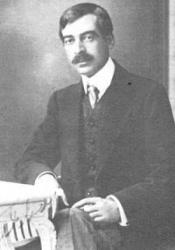
Geo Milev
 Bulgaria
- Early Life and Education
- Influences and Artistic Output
- Military Service and Political Activism
- Political Persecution and Death
- Legacy
Early Life and Education
Geo Milev was born on January 15, 1895, in Radne Mahle, near Radnevo, Bulgaria. His father was a teacher who moved the family to Stara Zagora, where he opened a bookstore and publishing house. Milev published his first poem in the children's magazine "Slaveyche" in 1907. He attended grammar school in Stara Zagora (1907-1911), where he edited handwritten magazines and illustrated anthologies, writing satirical, patriotic, and lyrical poems in the style of Pencho Slaveikov. During this time, he learned Russian and read Russian classics in the original.
He then studied Romance philology at Sofia University "St. Kliment Ohridski" (1911-1912) before continuing his education in Leipzig (1912-1914). There, he attended lectures on philosophy and theatrical arts and wrote a dissertation on the work of Richard Dehmel. It was during this time that his interest in contemporary German literature developed.
Influences and Artistic Output
From July to October 1914, Milev lived in London, where he met Émile Verhaeren. Verhaeren's work had a profound influence on Milev's entire literary output. Returning to Germany in October 1914, he was arrested in Hamburg on suspicion of espionage but was released after no evidence was found. He then returned to Bulgaria.
In 1915, Milev founded a theater group in Stara Zagora. Concurrently, he set out to introduce Bulgaria to contemporary European literature. He translated and published the works of poets such as Stéphane Mallarmé, Richard Dehmel, Paul Verlaine, and Émile Verhaeren, adding his own essays and dedicating each book to a Bulgarian symbolist poet (including Nikolai Liliev). He used his father's printing press, which had been drafted to the front, to publish these books.
Military Service and Political Activism
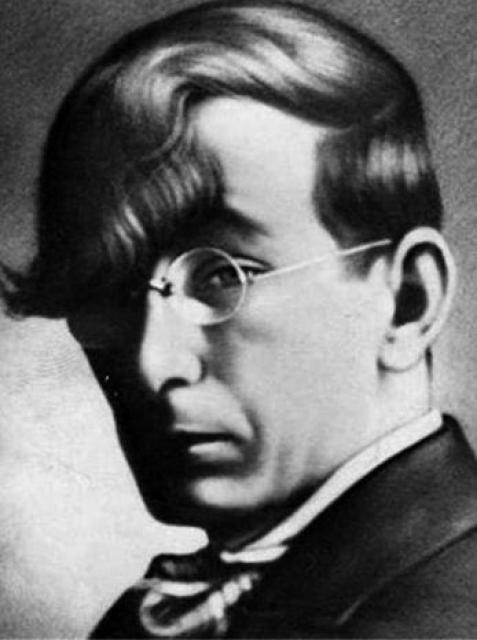
Drafted into the army in March 1916, Milev completed officer training and was sent to the front near Lake Doiran in September. On April 27, 1917, he was severely wounded in battle with British and Italian troops, losing an eye and sustaining serious head injuries. To conceal his lost eye, he wore a distinctive hairstyle that covered it for the rest of his life.
Sent to Germany for treatment in March 1918, he soon abandoned his recovery and immersed himself in the cultural life of Berlin. He lived there until March 1919 and became part of the expressionist circle that formed around Franz Pfemfert and his magazine "Die Aktion."
After returning to Sofia, Milev married actress Mila Keranova. The couple had two daughters and lived in cramped quarters in central Sofia due to financial constraints. From 1919 to 1922, he published the magazine "Vesni" (Scales), which became the central outlet for Bulgarian modernism, particularly symbolism.
Political Persecution and Death
By 1922 at the latest, Milev's apolitical work had become increasingly politicized. He joined the Bulgarian Communist Party that same year. From January 1924, he began publishing the sharply left-leaning magazine "Plamak" (Flame). In it, he notably published his poem "September," dedicated to the communist uprising of September 23, 1923. The issue was confiscated, and Milev was sentenced to a fine and a year in prison on May 14, 1925.
Amidst the anti-communist terror campaign waged by the government after the bombing of the St. Nedelya Church, Milev was summoned for questioning by the police on May 16. He never returned. Thirty years later, his body was identified in a mass grave in Ilyantsi, outside Sofia, where other prominent intellectuals had also been buried. A district in Sofia bears Geo Milev's name.
Legacy
His daughter, Leda Mileva (1920-2013), became a renowned poet herself.