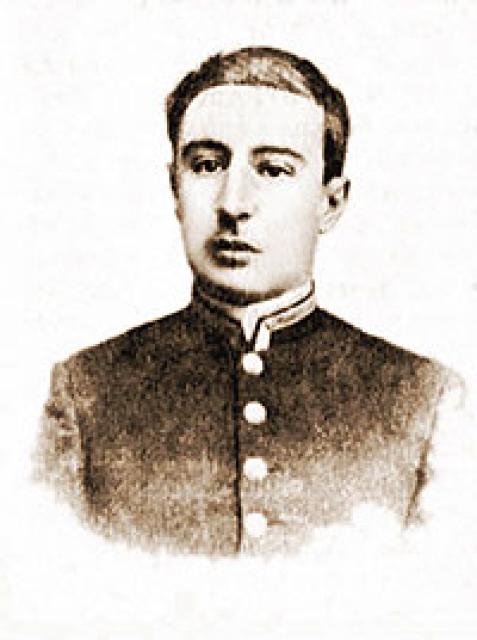
Wilgelm Zorgenfrei
- Early Life and Education
- Academic Journey
- Literary Beginnings and Influences
- Poetic Debut and Symbolism
- Collaborative and Independent Poetry
- Career and Post-Revolution
- Notable Translations and Legacy
- Final Collection and Financial Struggles
- Tragic End and Rehabilitation
- Posthumous Rehabilitation
Early Life and Education
Birth and FamilyWilhelm Sorgenfrei was born on August 11, 1882 (August 30 in the Gregorian calendar) in Akkerman, Bessarabia, into a military family of Livonian German descent. After losing his father in childhood, he lived with relatives in Pskov.
Academic Journey
In 1900, Sorgenfrei graduated from high school and enrolled in the Physics and Mathematics Faculty of St. Petersburg University. However, the following year, he transferred to the St. Petersburg Technological Institute. Upon graduating in 1908-1909, he taught mathematics at the Trade School.
Literary Beginnings and Influences
Early Political WritingsFrom 1904 onwards, Sorgenfrei published satirical poems and articles under pseudonyms in liberal newspapers, commenting on socio-political issues, including the Russo-Japanese War and the revolutionary events of 1905.
Poetic Debut and Symbolism
His poetic debut as a lyric poet came in 1905 in the Symbolist magazine "Voprosy Zhizni." In 1906, he met Alexander Blok, who became a significant influence on his literary career. Blok dedicated his poem "Steps of the Commander" to Sorgenfrei.
Collaborative and Independent Poetry
Sorgenfrei's poetry appeared in various publications, including "Zolotoye Runo," "Russkaya Mysl," and "Pereval." While his work was influenced by Russian Symbolism, he distanced himself from the movement's manifestos and ideologies.
Career and Post-Revolution
Ministry Service and TranslationsFrom 1909 to 1917, Sorgenfrei served in the Ministry of Trade and Industry. After the revolution, on Blok's advice, he transitioned to translating foreign literature into Russian. Maxim Gorky later engaged him as a translator for the publishing house "Vsemirnaya Literatura."
Notable Translations and Legacy
Among Sorgenfrei's notable translations were works by Stefan Zweig, Romain Rolland, Thomas Mann, Heinrich Heine, and Heinrich von Kleist. He considered his translation of Johann Gottfried Herder's poem "The Cid" to be his masterpiece.
Final Collection and Financial Struggles
In 1922, Sorgenfrei's only poetry collection, "Passionate Saturday," dedicated to Blok's memory, was published. Despite his literary pursuits, he faced financial difficulties and was forced to work as an engineer-technologist, his original profession.
Tragic End and Rehabilitation
Arrest and ExecutionIn 1938, Sorgenfrei was arrested on charges of counter-revolutionary activity and terrorist conspiracy. He was sentenced to death by the Military Collegium of the Supreme Court.


