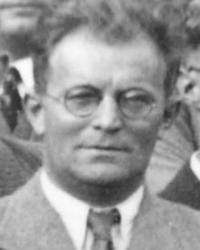
Georg Kraft
 Germany
Biography of Georg Krafft
Georg Wolfgang Krafft (Krafft) (1701 - 1754) was a German physicist. He was born in Titlingen and graduated from the University of Tübingen. From 1725 to 1744, he worked at the St. Petersburg Academy of Sciences, becoming an academician in 1727. In 1731, he was appointed an adjunct professor of "general mathematics," and in 1733, he obtained the chair of theoretical and experimental physics. In 1744, he became a professor of mathematics at the University of Tübingen.
Contributions to Physics
Krafft's works focused on hydrodynamics, heat, optics, acoustics, and magnetism. He conducted research on determining the refractive index and density of ice, as well as other properties of ice. He also studied the force of magnetic attraction. Krafft worked on improving various physical instruments, particularly thermometers and barometers. He was the first in Russia to conduct experiments in calorimetry and offered an empirical formula for the temperature of a mixture of hot and cold water.
Krafft played a significant role in organizing and expanding the physical laboratory at the St. Petersburg Academy of Sciences. He successfully obtained a large number of instruments and equipment for the laboratory and set up a physical auditorium for experimental demonstrations. Thanks to Krafft's efforts, the Academy's physical laboratory became one of the best in Europe.
Textbooks and Astrology
In addition to scientific articles, Krafft wrote several textbooks that served as guides in academic schools. These included "Einleitung zur mathematische und naturliche Geographie" (St. Petersburg, 1738, 1739, and 1764; translated into Russian in 1739 and 1764), which was used by Mikhail Lomonosov during his time as an adjunct professor. Krafft also wrote "Kurze Anleitung zur Erkenntniss der einfachen Maschinen und derselben Zusammensetzung" (1738; Russian translation in 1738 and 1802), among others.
According to Krafft's colleague at the Academy, Steklin, Empress Anna Ioannovna had a strong belief in astrological predictions and often approached the Academy with various questions and tasks. Steklin mentioned that Krafft, in particular, was highly skilled in astrology and solved remarkable problems based on astrological rules. For example, he was able to interpret the horoscope of the unfortunate Prince John without knowing his name.