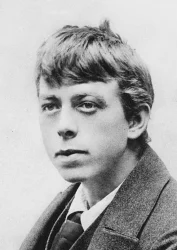
Georg Trakl
- Early Life and Literary Beginnings
- Poetry and the Innsbruck Circle
- War and Final Poems
- Death and Legacy
Georg Trakl was an Austrian poet whose brief career produced some of the most striking lyric poetry of early German-language Expressionism. His poems are known for vivid, dreamlike images of autumn, decay, solitude, and death, joined to a careful sense of sound and form. The violence he witnessed while serving as a medical orderly during the First World War became the subject of his final work.
Early Life and Literary Beginnings
Trakl was born in Salzburg on February 3, 1887, the son of a prosperous iron merchant. He was a reserved student whose interests lay increasingly in literature and the arts. After leaving school in 1905, he trained as a pharmacist, a profession that later gave him access to drugs on which he became dependent.
He continued to write while completing his apprenticeship and later studied pharmacy in Vienna from 1908 to 1910. His early experiments included plays and prose, though he destroyed some of the manuscripts after they failed to find an audience. Poetry gradually became his central form. His sister Margarete, known as Grete, was an important presence in his life; the intense and troubled bond between them is reflected in some of his poems through unsettling, sometimes incestuous imagery.
Poetry and the Innsbruck Circle
Trakl struggled to maintain steady employment and financial security, moving between pharmacy posts and short-lived jobs. His literary fortunes improved through his friendship with Ludwig von Ficker, editor of the Innsbruck journal Der Brenner. Beginning in 1912, the journal published many of Trakl’s poems and brought him into contact with writers and artists including Karl Kraus, Else Lasker-Schüler, and Oskar Kokoschka.
His first poetry collection, Gedichte, appeared in 1913. Trakl was developing a distinctive symbolic style in which landscapes and seasons seem to mirror inner states. Blue evening skies, fading gardens, silent streets, and autumn light recur as images of beauty shadowed by collapse. Rather than tell stories directly, his poems create emotional worlds through compressed images, repetition, rhythm, and striking color.
War and Final Poems
In August 1914, Trakl volunteered for military service and was sent to the Eastern Front as a medical supply officer. At the Battle of Gródek in Galicia, he was left responsible for caring for scores of severely wounded soldiers with little medical support. The experience overwhelmed him. After a breakdown and a suicide threat, he was admitted to a military hospital in Kraków.
During his hospitalization, he wrote “Grodek,” one of his best-known poems, along with “Im Osten” and “Klage.” The poems transform the battlefield into a vision of suffering and destruction, while retaining the formal intensity that marked his earlier work. “Grodek,” with its images of blood, darkness, and a dying world, is often read as both a personal response to the battle and a wider lament for the catastrophe of war.
Death and Legacy
Trakl died in Kraków on November 3, 1914, at the age of twenty-seven, from cocaine poisoning. Accounts have commonly described his death as suicide, following his despair over the battle and fear of a military inquiry. His second collection, Sebastian im Traum, was published posthumously in 1915.
His work was not widely recognized by a large public during his lifetime, but later readers came to regard him as a major early Expressionist poet. Trakl’s poems continue to draw attention for the tension at their heart: a world of remarkable musical beauty rendered amid decay, isolation, and violence.