George Carey
 Great Britain
- Early Life and Education
- Faith and Religious Journey
- Ecclesiastical Career
- Theological and Social Views
- Lambeth Conference and Anglican Unity
- Later Years and Legacy
Early Life and Education
George Leonard Carey, Baron Carey of Clifton, was born on November 13, 1935, in London's East End. Despite failing his 11-plus exam, Carey pursued his education, attending Dagenham's Bonham Road School and Barking School before leaving at 15. He worked as a messenger for the London Electricity Board before joining the Royal Air Force, where he served as a radio operator in Iraq.

Faith and Religious Journey
At 17, Carey experienced a spiritual awakening and became a devout Christian. He spent time in church with friends, and as he explains, "went through a very real conversion...There was no blinding light just a quiet assurance that I had found something." During his military service, Carey decided to pursue ordination.
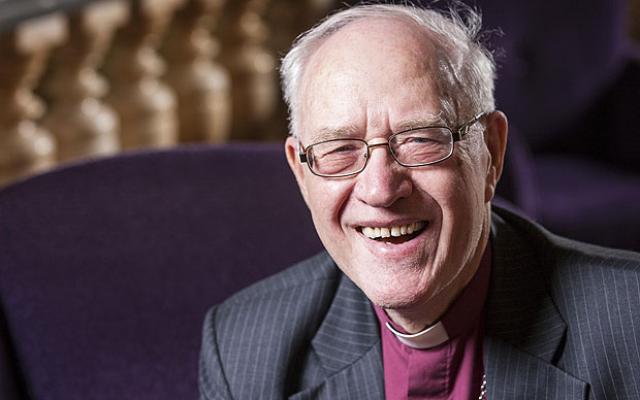
After discharge, Carey studied diligently, earned his A-level equivalencies, and entered King's College London. He graduated in 1962 with a Bachelor of Divinity, which entitled him to ordination. He later obtained his Master of Theology and Doctor of Philosophy degrees from Durham University. Carey became the first modern Archbishop of Canterbury to have not attended Oxford or Cambridge since Simon Sudbury in 1316-1318.

Ecclesiastical Career
Carey served as a curate at St. Mary's Church, Islington, and worked at Oak Hill Theological College and St. John's College, Nottingham. In 1975, he became vicar of St. Nicholas Church, Durham. Within two years, Carey founded a religious community, later detailing his experiences in the book "The Church in the Market Place." In 1982, he was appointed principal of Trinity College, Bristol.
In 1987, Carey became Bishop of Bath and Wells, and was enthroned in February 1988. He succeeded Robert Runcie as 102nd Archbishop of Canterbury after the latter's retirement. He was confirmed on March 27, 1991, and officially enthroned on April 19, 1991. Carey retired from his position on October 31, 2002, and was granted a life peerage the following day, becoming Baron Carey of Clifton. He was succeeded by Rowan Douglas Williams.
Theological and Social Views
Carey's theological roots lie in the evangelical tradition of the Anglican Church. He strongly supported the ordination of women and established close ecumenical links with the Roman Catholic Church. In 1976, he represented the Church of England at the Papal Council for Promoting Christian Unity in Rome.
Carey adopted a tolerant stance toward divorce, remarriage, and divorced people, with one of his sons being divorced. He supported Camilla Parker-Bowles' second marriage despite her first husband still being alive. While opposing homosexual relations among the clergy, Carey consented to consecrate two bishops who were believed to be in same-sex relationships.
Lambeth Conference and Anglican Unity
Baron Carey of Clifton presided over the 1998 Lambeth Conference and strongly backed a resolution that uncompromisingly rejected "incompatible with Scripture" same-sex relationships of any kind. However, he voted against the resolution's initial wording explicitly condemning homophobia.
The resolution, controversial in parts, prompted Richard Holloway, Bishop of Edinburgh and Primus of the Scottish Episcopal Church, to say, "I feel deeply disappointed...I feel betrayed. But the struggle will go on." Carey responded, "If this conference is known only for its discussion on homosexuality, we will have failed." Nonetheless, the resolution initiated an escalation in the crisis of unity within global Anglican churches, with debates on human sexuality continuing in the church to this day.
Later Years and Legacy
In 1999, Carey became one of four English bishops to openly state their unwillingness to sign the Cambridge Accord, an attempted compromise to accept limited rights for homosexuals. In an interview with David Frost, he said, "I don't believe in blessing same-sex unions because, quite frankly, I don't see what there is to bless."
In September 2009, Carey drew criticism from Anglicans when he made supportive remarks about the arms trade. Christian campaigners criticized him, invoking the Lambeth Conferences of 1988 and 1998, which had implemented opposition to the arms trade. In June 2014, Carey publicly supported the legalization of euthanasia for terminally ill patients.
Carey married Eileen Harmsen Good in 1960. The couple had two sons, Mark and Andrew, and two daughters, Rachel and Elizabeth. Mark went on to become an Anglican priest. Andrew served as Editor of the Church of England Newspaper and is now an independent journalist.