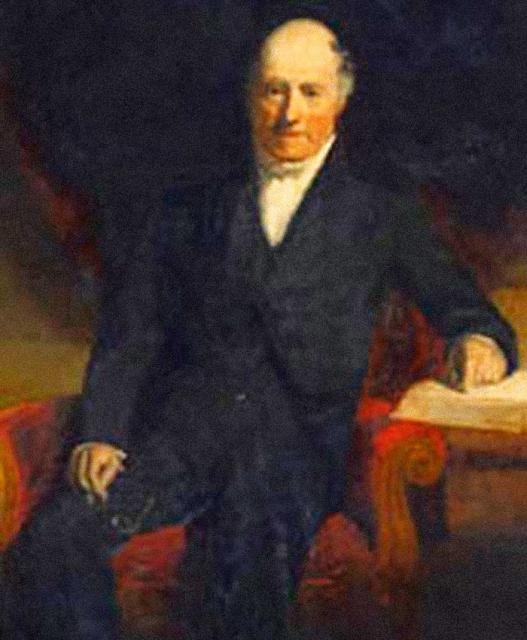
George Green
 Great Britain
George Green was a mathematician and physicist whose ideas became foundational to modern mathematical physics. In his own day, however, he was better known around Nottingham as a miller than as a scholar. Largely self-educated, he developed powerful new ways to describe electricity, magnetism and potential theory while helping run his family’s business. The work that later made his name famous was initially read by only a small circle.
A self-taught mathematician
Green was born in 1793 in Sneinton, near Nottingham. His father, also named George, was a baker and miller who built a windmill on a hillside at Sneinton. The younger Green had only a short period of formal schooling. As a boy he worked in his father’s bakery and later in the mill, where he eventually took on much of the daily management.
Alongside that work, Green taught himself advanced mathematics. Access to the Nottingham Subscription Library gave him a route to books and current scientific writing, and he studied ideas from British and continental mathematicians. His unusual blend of practical work and independent study let him develop beyond the limits of his formal education.
The 1828 Essay
In 1828, Green published “An Essay on the Application of Mathematical Analysis to the Theories of Electricity and Magnetism.” Printed through private subscription, it set out a mathematical framework for studying how forces and fields behave. It introduced the term “potential” in this context and contained results that became known as Green’s theorem, together with the foundations of what are now called Green’s functions.
The essay attracted little attention when it first appeared. Green continued working at the mill, and the significance of his mathematical approach was not widely recognized until the next generation. In 1845, the young William Thomson, later Lord Kelvin, encountered the essay and recognized its importance. Thomson helped bring it back into circulation, and it was republished in the European mathematics journal Crelle’s Journal over several years.
Cambridge and later research
After his father died in 1829, Green was able to leave the milling business and devote more time to mathematics. Encouraged by Sir Edward Ffrench Bromhead and other local supporters, he entered Gonville and Caius College, Cambridge, in 1833. At an age when most students had completed university, he began formal mathematical study.
Green performed strongly in the Mathematical Tripos, finishing as a high-ranking student, and graduated with a Bachelor of Arts in 1838. He was elected a fellow of his college the following year. His later papers extended his work into the motion of fluids, sound and the propagation of waves, subjects that connected mathematical analysis with physical phenomena.
A lasting mathematical legacy
Green’s academic career was short. In 1840, ill health led him to return to Sneinton, where he died on May 31, 1841, aged 47. His death came before he could see the full influence his ideas would gain.
Today, Green’s theorem and Green’s functions are central tools across physics and engineering, used to solve problems involving fields, forces and differential equations. His trajectory—from a boy working in a bakery and mill to a mathematician whose methods became standard—remains one of the striking stories in the history of science.


