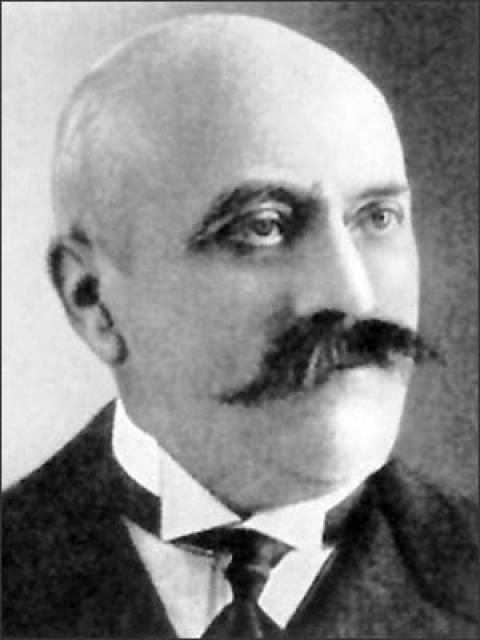
Georges Vacher de Lapouge
 France
- Georges Vacher de Lapouge
- Early Life and Education
- Anthropological Interests
- Anthropological Theories
- - Homo alpinus: A conservative, cautious race with limited genius.
- Academic Career and Controversies
- Later Years and Scientific Decline
- Legacy
Georges Vacher de Lapouge
Georges Vacher de Lapouge (1854-1936) was a French sociologist who became a prominent figure in the field of social Darwinism and one of the main ideologues of racism.
Early Life and Education
Born on December 12, 1854, in Neuville-du-Poitou, Vacher de Lapouge demonstrated an exceptional intellect and thirst for knowledge from an early age. After graduating from high school, he enrolled at the Paris Medical School and the Faculty of Law, where he earned a doctorate in law in 1879. He initially pursued careers as a deputy prosecutor and prosecutor.
Anthropological Interests
In 1883, Vacher de Lapouge moved to Paris and began attending courses at the School of Anthropology. He expanded his knowledge by studying Chinese, Japanese, Hebrew, Egyptian languages, and Egyptology at the School of Oriental Languages, the École Pratique des Hautes Études, and the Louvre School. As a result of his studies, he developed a keen interest in race and social hierarchy.
Anthropological Theories
Vacher de Lapouge divided Europeans into three main races:- Homo europaeus: A race characterized by vanity, energy, intelligence, and idealism.
- Homo alpinus: A conservative, cautious race with limited genius.
- Homo mediterranaeus: A race morally inferior to the other two.He believed that long-headed blonds played a crucial role in society, while short-headed individuals and their mixed offspring served as the "muscles and bones." Vacher de Lapouge attributed the formation of elite classes in ancient civilizations to the blond dolichocephalic race.
Academic Career and Controversies
In 1886, Vacher de Lapouge delivered a lecture titled "Anthropology and Political Science," in which he predicted future wars of annihilation due to racial differences. His ideas sparked controversy and significantly influenced his career path. In 1909, he was denied a professorship at the Anthropology Institute and moved back to Poitiers, where he became a librarian.
Later Years and Scientific Decline
Vacher de Lapouge gradually abandoned his anthropological research and returned to his childhood fascination with entomology. In his later years, he faced criticism and ostracism within the scientific and political communities due to his controversial views. He began publishing his works on anthroposociology in German and American journals.
Legacy
Vacher de Lapouge's theories were rejected in France by the turn of the 19th century. His racist and elitist ideas, however, influenced the development of the Nazis' ideology and legitimized the exclusion and discrimination of minority groups. Despite the scientific flaws and immoral nature of his theories, Vacher de Lapouge's work remains a significant chapter in the history of social thought and the dangers of scientific racism.


