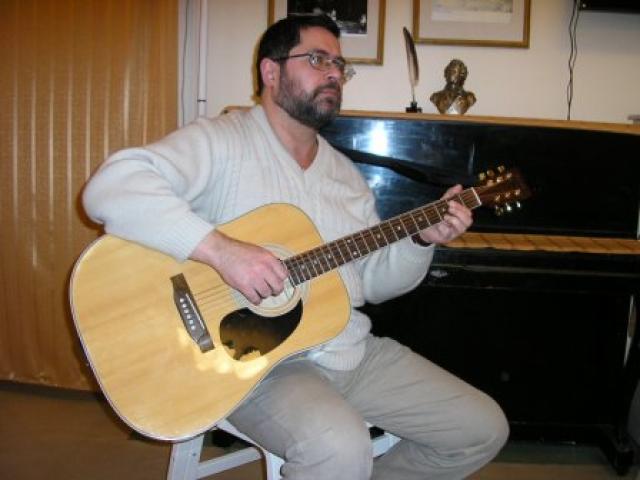
Georgiy Georgievsky
 Latvia
- From Riga to Jõhvi
- Songs, poems, and old stories
- A literary voice in Estonia
- The bard and the “bylinist”
Georgiy Georgievsky has built a distinctive literary life at the meeting point of song, poetry, folklore, and history. Born in Riga, he moved to Estonia as a small child and became part of its Russian-language literary community. His writing ranges from spiritual lyrics and historical ballads to satire, fairy-tale verse, and songs shaped by the language of the Russian epic tradition.
From Riga to Jõhvi
Georgievsky was born in Riga, Latvia, on April 29, 1958. In 1960, his family moved to Estonia, where he grew up and later settled in the town of Jõhvi. Before turning to literature full time, he worked as a sports coach, journalist, and staff member at the cultural center Polisvetie.
Sport was more than a passing interest. During the late 1970s and 1980s, Georgievsky became a multiple Estonian champion and record holder in powerlifting and earned the title of Master of Sport of the USSR. The discipline of that athletic background sits alongside a very different creative identity: a poet who writes songs and performs them himself.
Songs, poems, and old stories
Georgievsky began writing poetry and songs in the mid-1980s. His work has appeared in literary journals and publications in Estonia, Latvia, and Russia, including *Baltika*, *Kreshchatik*, *Polisvetie*, *Raduga*, and *Tallinn*. His first collection, *An Alloy of Immortality, Love and Sorrow*, appeared online in 2017.
A recurring strength in his writing is the way he reworks older forms for a contemporary audience. He draws on the Russian bylina, the traditional epic song, and the elevated conventions of the ode. His subjects move from ancient history and legendary heroes to faith, private reflection, and everyday absurdities. Titles such as “The Song of Jason, Leader of the Argonauts,” “Hannibal,” and “The Lament of Archpriest Avvakum” hint at the range of his historical imagination.
His poetry-song catalog also includes spiritual verses, lyrical songs, historical pieces, poetic mythology, satire, and fairy tales. Rather than confining himself to a single genre, he moves between these forms, pairing antiquated rhythms and imagery with a contemporary sense of humor and personal voice.
A literary voice in Estonia
Georgievsky became a member of the Association of Russian Writers of Estonia and the Estonian branch of the Russian Writers’ Union. He also led the Polisvetie creative association, connecting his work to a broader Russian-language cultural community in Estonia.
Since 2009, he has described himself as a freelance writer. His career reflects a gradual shift from coaching and journalism toward literary work, while retaining his close ties to the place where he has spent most of his life.
The bard and the “bylinist”
Georgievsky is known as both a performer of original songs and an author of poetry. That dual role shapes the texture of his work: the poems are built not only for the page but also for voice, rhythm, and performance. His interest in epic language and historical memory gives the songs a deliberately old-fashioned grandeur, while lyric and satirical pieces keep the tone personal and playful.
From strength-sport records to literary journals, his path has been unusually varied. Today he is best understood as a Russian-language poet and bard rooted in Estonia, drawing on the region’s layered cultural history to create songs and poems that move between the ancient and the immediate.




