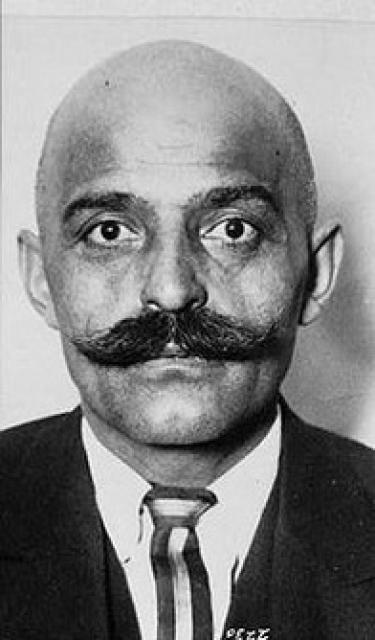
Georgiy Gurdjiev
- Philosopher, Mystic, Writer, Composer, and Traveller
- Early Life and Influences
- "Seekers of Truth"
- Moscow and St. Petersburg
- The Caucasus and Emigration
- Institute for the Harmonious Development of Man
- The Prieuré and Gurdjieff's Legacy
- Postmortem Influence
Philosopher, Mystic, Writer, Composer, and Traveller
George Ivanovitch Gurdjieff (January 13/14, 1866 – October 29, 1949) was a Russian mystic, spiritual teacher, author, composer, traveller, and forced emigrant whose teachings, known among his followers as "The Fourth Way," were dedicated to the self-development of individuals and their growth in consciousness and being in everyday life.
Early Life and Influences
Gurdjieff was born in Alexandropol (now Gyumri), Armenia, to a Greek father, Ivan Ivanovich Gurdjieff, and an Armenian mother from the Tavrizovs-Bagratuni clan. He claimed that both his father, who was a merchant and craftsman, and his spiritual father, the abbot of the local Christian church, Father Borsh, sparked his thirst for knowledge about the process of life on Earth, particularly the purpose of human existence.
"Seekers of Truth"
Gurdjieff began travelling extensively throughout Asia and Africa in his early adulthood, seeking answers to questions that fascinated him. He visited countries such as Greece, Egypt, Turkey, Afghanistan, Turkestan, and other regions in the Middle East. These journeys were often undertaken with a group known as "The Seekers of Truth," of which Gurdjieff was a member. During his travels, he studied diverse spiritual traditions, including Sufism, Buddhism, and Eastern Christianity, collecting fragments of ancient wisdom along with spiritual music and ritual dances from the countries he visited.
Moscow and St. Petersburg
In 1912-1913, Gurdjieff arrived in Moscow, where he gathered a small group of students around him. In the spring of 1915, he met P.D. Ouspensky, a philosopher, journalist, and author known for his writings on philosophy and travel. Having already searched for answers in the East, Ouspensky was drawn to Gurdjieff's teachings and became his student for seven years.
The Caucasus and Emigration
The October Revolution of 1917 found Gurdjieff and his commune of students in Essentuki, in the North Caucasus. With the onset of the Civil War, he embarked on a perilous journey with several students through the Caucasian passes towards Tiflis. From there, they were forced to flee to Constantinople.
In Tiflis, Gurdjieff was joined by theatrical artist and set designer Alexandre de Salzmann and his wife, Jeanne de Salzmann. Jeanne de Salzmann would later play a significant role in spreading Gurdjieff's teachings in France and connecting him with new students after the closure of the Institute at the Prieuré.
Institute for the Harmonious Development of Man
Gurdjieff made several attempts to establish an "Institute for the Harmonious Development of Man," first in Tiflis in 1919 and then in Constantinople in 1920. In 1921, he moved to Germany and later, following Ouspensky, attempted to resettle in Great Britain, but his followers were denied entry by the authorities.
In 1922, Gurdjieff and his followers, who had accompanied him from Moscow and St. Petersburg, during the revolution to the Caucasus, and then to Constantinople and eventually to Europe, purchased the Prieuré estate near Fontainebleau, outside Paris. The property became the long-awaited home of the Institute for the Harmonious Development of Man, which would operate for several years.
The Prieuré and Gurdjieff's Legacy
The large estate attracted curious visitors, including English followers of Ouspensky, then Americans. Prominent literary figures, publishers, and doctors were among the visitors, including:
Alfred Richard Orage, an essayist and editor who sold his "The New Age" magazine to dedicate himself to the Institute.
Catherine Mansfield, a renowned novelist whose untimely death at the Prieuré in 1923 sparked controversy.
Margaret C. Anderson, publisher of "The Little Review" literary magazine.
Notable French students included René Daumal and Luc Dietrich, who sought metaphysical knowledge. Gurdjieff's teachings also influenced Denis Saurat, the director of the British Institute in Paris.
Gurdjieff emphasized awakening dormant thought and a sense of true reality in his students. He utilized art, sacred dances, and group work to facilitate self-awareness among individuals. His writings, including "In Search of the Miraculous" by P.D. Ouspensky, provide insights into his ideas. Gurdjieff's unique style of presenting his concepts, known as legomonism, was intended to encourage intuitive understanding rather than relying solely on logical reasoning.
In 1923, Gurdjieff and his students debuted their sacred dance and movement demonstrations at the Théâtre des Champs-Élysées in Paris, an event that showcased their teaching methods and sought to educate the public.
Gurdjieff and Ouspensky parted ways in 1924, with Ouspensky returning to the United Kingdom. Gurdjieff, along with four dozen students, travelled to New York the same year to present a series of theatrical performances, seeking to introduce his ideas to American audiences. In 1924, he suffered a near-fatal car accident from which he struggled to recover. After the accident, he decided to partially close the Institute and focus on writing, aiming to make his ideas accessible to a wider audience.
Postmortem Influence
After Gurdjieff's death, his student Jeanne de Salzmann united various groups of followers, establishing the Gurdjieff Foundation in the United States and the Gurdjieff Society in Europe. Other notable individuals who played a role in disseminating Gurdjieff's ideas include British mathematician John G. Bennett, psychiatrist Maurice Nicoll, writer Rodney Collin, and Lord Pentland. P.D. Ouspensky's writings also contributed to the spread of Gurdjieffian teachings.
Gurdjieff's legacy continues through music and other creative expressions. In 1949, Thomas de Hartmann, Gurdjieff's musical collaborator, edited their compositions. These works were later performed by pianist Keith Jarrett in 1980 and recorded as "G.I. Gurdjieff Sacred Hymns." In 2011, the "Gurdjieff Folk Instruments Ensemble" recorded selected pieces of Gurdjieff's music, arranged by Levon Iskenian to restore the ethnographic sound intended by Gurdjieff.
Gurdjieff's writings and ideas continue to resonate with readers globally, inspiring personal development, self-awareness, and the exploration of spiritual truths in everyday life.



