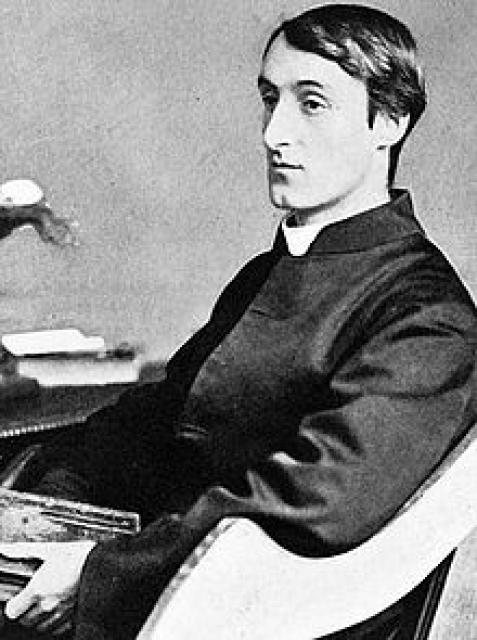
Gerard Hopkins
 Great Britain
- Biography of Gerard Hopkins
- Early Years and Conversion to Catholicism
- Exploring Poetry and Joining the Jesuits
- Career and Contributions
- Major Poems and Themes
Biography of Gerard Hopkins
Gerard Hopkins was an English poet and one of the recognized innovators in 19th-century literature. He was born on July 28, 1844, in Stratford, Essex County. During his school years in Highgate, Hopkins displayed talents as a philologist and poet. In 1863, he enrolled in Balliol College, Oxford University, and converted to Catholicism during his final year. He graduated from the university with special distinction.
Early Years and Conversion to Catholicism
Hopkins was born on July 28, 1844, in Stratford, Essex County. In his school years in Highgate, he revealed his talents as a philologist and poet. In 1863, he enrolled in Balliol College, Oxford University, and converted to Catholicism during his final year. He graduated from the university with special distinction.
Exploring Poetry and Joining the Jesuits
1868 was a turning point for Hopkins when he burned his early poems and became a novice in the Jesuit order. He returned to poetry in 1875, creating "The Wreck of the Deutschland," his first work in his distinctive style. After this, he wrote little, but what he did write was the quintessence of emotion, creative imagination, and syntactic innovations. In 1877, he was ordained as a Jesuit priest.
Career and Contributions
In 1884, Hopkins became a professor of Greek at University College Dublin. He passed away in Dublin on June 8, 1889. His first collection of poems, prepared by poet R. Bridges, was published in 1918. Hopkins made significant contributions to poetry through his concepts of "inscape" and "sprung rhythm." "Inscape" referred to the unique, unrepeatable form of everything in existence. According to Hopkins, everything in the world is "inharmonious, fresh, secret, unseen" (Pied Beauty), including the poem itself, as it strives to reflect the unique inscape of reality. "Sprung rhythm," which had a profound influence on contemporary poets, involved a strict number of stressed syllables per line and arbitrary, unstressed syllables, resulting in varying line lengths. This rhythm approximated the pace of excited conversational speech but could lead to stylistic carelessness. To avoid this, Hopkins employed internal and end rhymes, alliteration, assonance, and other techniques, not for mere decoration but to reveal the content. Sprung rhythm corresponded to inscape as it made each poem unique in its form.
Major Poems and Themes
Hopkins' most significant poems are mostly religious and can be roughly divided into three sequential groups. In "Pied Beauty," nature is interpreted as a reflection of God. In "The Windhover," the beauty of nature relates to the sublime beauty of the spirit. His later poems juxtapose nature and humanity. In his last years in Dublin, Hopkins delved into the dark depths of the soul, creating the famous "terrible" or Dublin sonnets.


