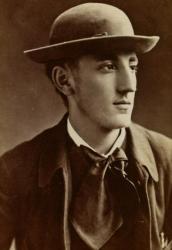
Giacomo Balla
 Italy
ItalyBiography of Giacomo Balla
Giacomo Balla was an Italian artist and one of the founders of Italian Futurism. Born in Turin into a pharmacist's family, Balla initially worked in a lithography workshop and attended art courses at an evening school. However, due to excessive workload, he fell into depression and, in 1891, decided to leave the workshop and dedicate himself entirely to art.
Years of Study
For several months, Balla attended the "Accademia Albertina" in Turin and then practiced in a photo studio. In 1893, he moved to Rome, where he earned a living by drawing caricatures and designing packaging. In the late 1890s, Balla experimented with light effects. During his time in Paris in 1900, he studied the works of French Neo-Impressionists Georges Seurat and Paul Signac.
First Futurist Manifesto
At the beginning of the 20th century, Balla quickly gained a reputation as a portraitist. Many of his works from that period were influenced by photography, often using only black and white colors and employing photographic perspective. In 1904, he married Elisa Marcucci, to whom he had been engaged for a long time. As his paintings sold poorly, he had to give private drawing lessons. Through his students Umberto Boccioni and Gino Severini, he met Filippo Tommaso Marinetti, a writer advocating for a new art and demanding a break from all past styles and forms of thinking. In 1909, Balla became one of the signatories of the Founding Manifesto of the Futurists.
Capturing Movement
Like most Futurists, Balla was primarily interested in capturing movement and dynamics. He turned to photography again, studying the "studies of movement" by photographers Jules Etienne Marey and Eadweard Muybridge. Balla aimed to simultaneously convey different phases of movement, exemplified in his painting "Dynamism of a Dog on a Leash" (1912). In his painting "Girl Running on a Balcony" (1912), he applied a color rhythm by overlaying equally-sized colored dots. Using transparent paints, he achieved an unprecedented fusion of figure and surroundings, exemplifying the Futurist principle of "Synthesis of time, place, form, color, and tone." He later represented the movement of an automobile and the flight of a swallow in his artworks from 1913. Alongside his exploration of light, he created abstract compositions, such as "Mercury Passing in Front of the Sun - View Through a Telescope" (1914).
Spiritualism
In 1915, deeply concerned about Italy's involvement in World War I, Balla, together with Fortunato Depero, proclaimed the manifesto "On Futurist Reconstruction of the Universe." During this time, he also created so-called "plastic complexes" - movable constructions made of wire, cardboard, and glossy paper. He later produced other ensembles and sketches of everyday objects. In the early 1920s, Balla became interested in spiritualism, which greatly influenced his artistic practice. Through painting, he attempted to convey the phenomenon of cosmic radiation in his work "Transfiguration of Spiritual Forms" (1920). He maintained his connection with Futurism and, in 1929, signed the manifesto of the "Aeropittura" group, proclaiming the advent of the second period of Futurism. His works from this period, such as "Chair of a Strange Man" (1929), continued the direction of "Pittura Metafisica" pioneered by Giorgio de Chirico, featuring mysterious and surreal motifs with metaphysical undertones. In the late 1930s, Balla moved away from Futurism and returned to traditional figurative painting. He passed away in Rome in 1958 at the age of 86.