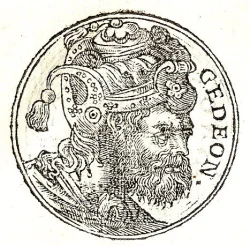
Gideon
Gideon’s story in the biblical Book of Judges begins with hesitation and ends with a victory remembered for its unlikely scale. Called to deliver the Israelites from Midianite raids, he asks for reassurance, gathers an army, and is instructed to reduce it to just 300 men. The account presents him as both a reluctant leader and a complicated figure whose success does not bring lasting unity.
Call to Leadership
Judges 6 describes the Israelites as suffering repeated raids by Midian and allied groups. According to the narrative, Gideon was threshing wheat in a winepress to hide it from raiders when an angel appeared and addressed him as a “mighty warrior.” Gideon questioned why Israel had suffered and doubted his own ability to lead.
He was told to destroy his father’s altar to Baal and build an altar to the God of Israel. Gideon carried out the order at night, fearing the reaction of his community. When local men demanded his death, his father argued that Baal should defend himself if he were truly a god. The episode earned Gideon the name Jerubbaal.
The Fleece and the Battle
As Midianite forces gathered, Gideon sought confirmation of his mission through signs involving a fleece of wool. In one test, dew covered the fleece while the ground remained dry; in the next, the fleece stayed dry while the ground was wet. The story presents these requests as signs that strengthened his confidence.
Gideon assembled an army, but the narrative says God ordered him to send most of the men home so that Israel could not claim victory through its own strength. Only 300 remained. Armed with trumpets, jars, and torches, they surprised the Midianite camp at night. Confusion spread among the opposing forces, and the Midianites fled. The account credits Gideon with a decisive victory and describes the Israelites pursuing their retreating enemies.
Leadership and Its Costs
After the battle, the tribe of Ephraim confronted Gideon for not involving them earlier. He calmed their anger through diplomacy. He also sought provisions from the towns of Succoth and Penuel for his exhausted troops; when refused, he later punished those communities. These episodes complicate the portrait of a leader who had first resisted the call to power.
The Israelites asked Gideon to rule over them and establish a dynasty. He refused, saying that God should rule, but he accepted gold from the spoils and made an ephod, a religious object, in his hometown. The narrative says this became a snare to Gideon and his household. After his death, the people returned to worship other gods.
Legacy in Biblical Tradition
Gideon is remembered in Jewish and Christian traditions as a judge, military deliverer, and example of faith tested by uncertainty. His fleece has become a familiar image for asking for a sign, while the victory of the 300 is often invoked as a story of courage against overwhelming odds.
The Book of Judges does not offer a modern historical biography, and the events are known through its religious narrative. Within that account, Gideon’s life carries a warning alongside its triumph: military success and personal authority do not guarantee a stable or faithful society after a leader is gone.