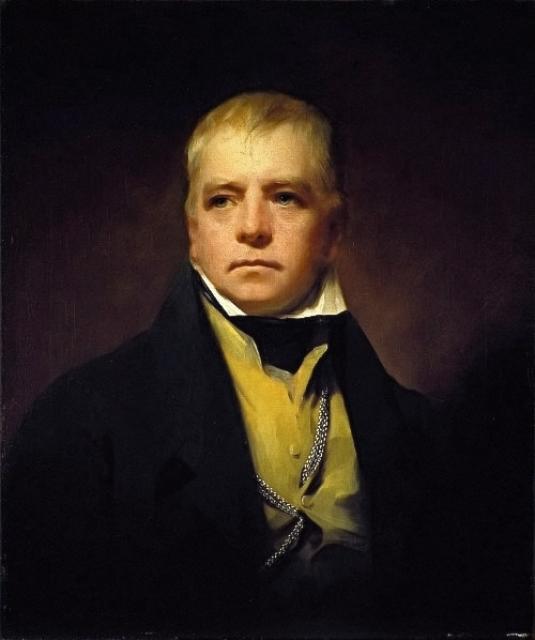
Walter Scott
 Great Britain
- Biography of Walter Scott
- Education and Career
- Literary Success
- Novels and Later Life
- Later Years and Legacy
Biography of Walter Scott
Early LifeWalter Scott was born on August 15, 1771, in Edinburgh, Scotland. His parents were Walter Scott, a lawyer, and Anne Rutherford, the daughter of a professor of medicine at the University of Edinburgh. In his early childhood, Scott lived in Sandynow, on his grandfather's farm, recovering from what is now believed to be polio. It was there that he heard stories and ballads about Scottish outlaws who had once roamed the area.
Education and Career
Scott acquired most of his extensive knowledge through self-education, rather than formal schooling. He had a phenomenal memory, which allowed him to remember everything that interested him. He did not need to study specialized literature before writing a novel or poem, as his vast knowledge enabled him to write on any chosen topic. Despite his literary success, Scott pursued a career as a lawyer at his father's request. He worked as a barrister and later became a sheriff in Selkirkshire in 1799, and ultimately one of the principal clerks of the Supreme Court of Scotland in 1866.
Literary Success
Scott's first publications were translations of works by German author G.A. Burger and German poet Johann Wolfgang von Goethe. While many of his early works were influenced by the gothic school and its "horror novels," Scott became fascinated with Scottish ballads in the 1790s. In 1802, he published a collection of selected ballads titled "Minstrelsy of the Scottish Border," which brought him recognition. Scott's first major poem, "The Lay of the Last Minstrel," was published in 1805 and quickly gained popularity. It showcased his storytelling skills, the successful combination of reality and imagination, and his ability to captivate readers with regional material. This was followed by several more poems, including "Marmion," "The Lady of the Lake," and "The Lord of the Isles."
Novels and Later Life
In 1814, Scott's first novel, "Waverley," was published anonymously and marked a new phase in his career. Although the novel was set in Scotland, it was not strictly historical, and Scott continued to write novels that spanned various time periods and locations. His novels often featured real historical figures but focused more on the overall human nature rather than the historical events themselves. Scott's most famous novels include "Ivanhoe," "Rob Roy," and "Kenilworth." However, financial difficulties caused by the bankruptcy of his publisher and printer in 1825 led Scott to work tirelessly to pay off his debts. This exertion took a toll on his health, and he suffered from several strokes.
Later Years and Legacy
In October 1831, Scott traveled to Italy for medical treatment but soon returned to Scotland. He spent his final months in a semi-conscious state and passed away on September 21, 1832, at his beloved home, Abbotsford. Scott's contribution to literature, particularly his novels, has left a lasting legacy, and he is often regarded as one of the greatest British writers of all time.


