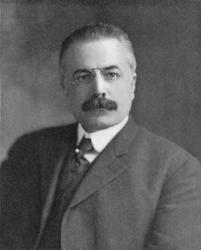
Giovanni Botero
 Italy
ItalyBiography of Giovanni Botero
Giovanni Botero, an Italian philosopher, writer, and politician, was born around 1544 in the northern Italian principality of Piedmont. He received his education at the Jesuit College in Palermo until the age of 15, after which he transferred to the Roman College in Rome. In 1565, he was sent to teach philosophy and rhetoric at Jesuit colleges in France, starting in Billom and later in Paris.
During the late 16th century, religious wars tore France apart, and Botero experienced the consequences of the internal division while residing in Paris from 1567 to 1569. After demonstrating his anti-Spanish protest fervently, Botero was recalled to Italy. In the 1570s, he moved between different Jesuit colleges. However, in 1580, due to his loosely interpreted doctrinal teachings, Botero was summoned for questioning by the Papal authority and expelled from the Jesuit order.
Giovanni became the personal assistant to Bishop Carlo Borromeo in Milan. The bishop introduced him to the ecclesiastical administration, which had close ties to the nobility of northern Italy. After Carlo's death in 1584, Botero continued his service under Carlo's nephew Federico. However, in 1585, he spent most of his time in France on the orders of Charles Emmanuel I.
By the late 1580s, Botero had already published several works, including a poem dedicated to Henry III and notes on the Hebrew Scriptures titled "On Kingly Wisdom." In 1588, he released "On the Causes of the Greatness of Cities," a notable work that anticipated the ideas of Thomas Malthus.
A year later, Botero completed his most famous work, "The Reason of State" ("Della ragion di Stato" or "The Welfare of the State"). In this work, he argued that princely power should be harmonized with the needs of the subjects, and rulers should strive to win the love and respect of the people. This idea of justice was shaped by Botero's exposure to Thomist thought and natural law, prevalent in the Jesuit college system, which was strongly influenced by Dominican theologian Francisco de Vitoria and scholastic philosopher Domingo de Soto.
In the 1590s, Botero continued to serve Federico Borromeo, who became the Archbishop of Milan in 1595. During this period, Giovanni moved in the highest circles of Rome and Milan and wrote another well-known work called "Relazioni Universali." It was published in four volumes between 1591 and 1598, with the fifth volume released at the end of the 19th century.
Botero's service to Federico Borromeo ended in 1599, and he returned to the Savoy dynasty, where he became the tutor of three sons of Charles Emmanuel. From 1603 to 1607, Giovanni made three trips to Spain, during which he undoubtedly engaged with close advisers of Philip III. These advisers conveyed his ideas to Philip IV's most trusted confidant, the Count-Duke of Olivares. Olivares likely used Botero's work, "The Reason of State," to outline a general strategy for preserving the Spanish Empire in his famous work, "Memorial on the Union of Arms." There is evidence that Maximilian, Duke of Bavaria, one of the staunchest political supporters of Catholic reform and a leading figure in the Thirty Years' War, discussed "The Reason of State" with his advisers.