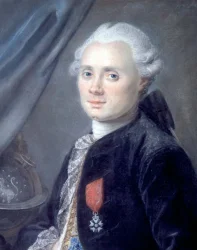
Giovanni Schiaparelli
- From Piedmont to the observatory
- A breakthrough in meteor astronomy
- Mapping Mars
- Scholarship beyond the planets
- Legacy
Giovanni Schiaparelli’s careful observations of Mars helped ignite one of astronomy’s most famous misunderstandings. In Italian, he called the planet’s faint linear markings canali, meaning channels; in English, the word became “canals,” encouraging speculation that intelligent beings had built waterways across the Martian surface. Yet his achievements stretched far beyond that controversy, from explaining meteor showers to studying the astronomy of antiquity.
From Piedmont to the observatory
Schiaparelli was born on 14 March 1835 in Savigliano, Piedmont, then part of the Kingdom of Sardinia. Fascinated by the night sky from a young age, he studied engineering and mathematics in Turin before continuing his scientific education in Berlin. He also spent time at the Pulkovo Observatory near St. Petersburg, one of Europe’s leading centers for astronomical research.
In 1860, he joined the Brera Observatory in Milan. Two years later, he became its director, a position he held until 1900. Under his leadership, Brera became an important center for observational astronomy, even as Italy itself was undergoing unification and the building of a modern scientific state.
A breakthrough in meteor astronomy
Schiaparelli’s work ranged across the solar system. In the 1860s, he showed that meteor showers follow orbits closely related to those of comets. His studies connected the Perseids with a comet and similarly linked the Leonids to another comet. This helped establish that meteor streams were not isolated celestial curiosities but part of the wider dynamics of the solar system.
He also studied double stars, planetary motion and the apparent distribution of stars. His work combined precise observation with mathematical analysis, and he was known for caution in drawing conclusions from limited evidence.
Mapping Mars
Mars came into especially favorable viewing conditions in 1877, and Schiaparelli used the Brera telescope to produce detailed maps of its surface. He recorded a network of fine, straight-looking markings and called them canali. The Italian term can describe natural channels or grooves; it does not itself imply construction by intelligent beings.
The English translation “canals” carried a stronger suggestion of artificial waterways. American astronomer Percival Lowell later popularized that interpretation, proposing that the lines were part of a planet-wide irrigation system built by Martians. Schiaparelli’s observations thus became entangled with ideas he had not established. Better telescopes and spacecraft eventually showed that the supposed canals were not real engineered features.
Scholarship beyond the planets
Schiaparelli was also a historian of astronomy. After retiring from regular observing, he devoted more time to ancient astronomical traditions, examining how civilizations in the Middle East and Mediterranean understood the sky. His command of languages and interest in historical texts allowed him to connect scientific questions with the intellectual worlds that produced them.
His public service extended into politics as well. In 1889, he was appointed to the Italian Senate, reflecting the esteem in which he was held in the newly unified kingdom.
Legacy
Schiaparelli died in Milan on 4 July 1910. His name remains linked to the Martian canals, but that episode should not eclipse the soundness and breadth of his scientific career. His research on meteor showers helped clarify the relationship between comets and meteors, while his Mars maps advanced planetary observation. The “canal” controversy is a lasting reminder that scientific discoveries can be reshaped by translation, expectation and the stories people want the evidence to tell.