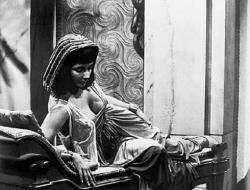
Giulia Farnese
 Italy
ItalyBiography of Giulia Farnese
Giulia Farnese, a representative of the Farnese dynasty, was the mistress of Pope Alexander VI (Rodrigo Borgia). Her extramarital affair played a significant role in promoting her family's status. She was born in Canino, Italy, Lazio, to Pier Luigi Farnese, the Lord of Montalto (1435-1487), and his wife Giovanna Caetani. They had five children together: Alessandro, who would become Pope Paul III, Bartolomeo, who inherited the Montalto estate and married Iolanda Monaldeschi, and Jeronima.
At the age of 15, on May 21, 1489, Giulia married Orsino Orsini, who was the stepson of Adriana de Mila, a distant relative of Cardinal Rodrigo Borgia, who was then the Vice-Chancellor of the Church and the future Pope Alexander. Giulia's husband was described as cross-eyed and lacking self-confidence. It is unclear when the young Giulia caught the attention of the already aging Borgia, replacing Vannozza dei Cattanei, the mother of Cesare and Lucrezia. However, Adriana de Mila, his cousin, eventually gave her consent to the extramarital affair, with the purpose of raising Orsino's status in the Vatican. In November 1493, Giulia, together with Adriana and her lover's daughter Lucrezia Borgia, whom they befriended, moved to a palace near the Vatican. Rumors of their relationship quickly spread, and Giulia became known as the "papal whore" and the "bride of Christ" (concubina papae; sponsa Christi). Thanks to her intimate relationship with the pontiff, Giulia secured a cardinal's hat for her brother Alessandro.
Giulia gave birth to a daughter named Laura, but it is uncertain whether her husband or lover was the father. Giulia adamantly claimed that her lover, Pope Alexander, was the father, but this may have been a way to solidify her own status and her daughter's position. In 1494, Giulia angered the Pope by going to Capodimonte to be by her dying brother Angelo's bedside. Consequently, she refused to return to Rome even after her brother's death. Eventually, she surrendered and decided to return to her lover. However, at that time, the French were at war in Italy, and Giulia was captured by French Captain Yves d'Allegre, who demanded and received a ransom of 3,000 scudi from the Pope.
She remained the Pope's mistress until around 1499-1500, when she was likely dismissed due to her age. Her husband Orsino also died around the same time. Giulia moved to Carboniano, a town near Rome, which had been gifted to her by her lover. In 1503, the Pope passed away, and in 1505, Giulia returned to Rome to attend her daughter Laura's wedding to Niccolo della Rovere (son of the Pope's sister, Juliana II).
Despite her age, Giulia continued to pursue love. After a series of lovers whose names have not been preserved, she decided to marry Giovanni Capece from Bozzuto, a Neapolitan nobleman. In 1506, Giulia became the ruler of Carboniano, and her residence became a castle. Chronicles claim that she was a capable administrator and governed in a precise and energetic manner. She remained in the town until 1522 when she returned to Rome.
In Rome, at the age of fifty, she passed away in her brother Cardinal Alessandro's house for unknown reasons. Ten years later, Alessandro would become Pope. Her daughter Laura gave birth to three sons who inherited the Orsini property. Due to her beauty, she was known as Giulia la Bella - "Beautiful Giulia." Lorenzo Pucci described her as "a beautiful sight to behold." Her lover Cesare Borgia's son described Giulia as "dark-eyed, with a round face and a special passion."
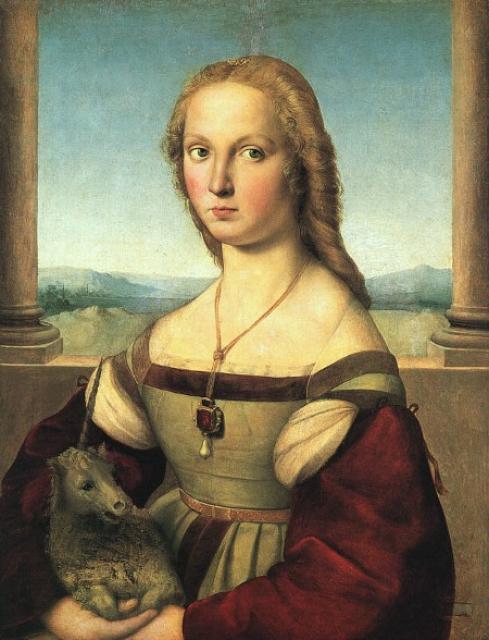
There are no exact portraits of Giulia Farnese preserved, but it is believed that she is depicted in several female portraits where a lady with a unicorn, the emblem of her family, is painted. One of them is attributed to Raphael, but it is rather disputed whether it portrays Giulia. A more reliable, although less high-quality, image is considered to be a depiction by Luca Longhi.
In his famous work on painters (1568), Vasari mentions a painting by Pinturicchio: "In the same palace, he depicted above the door of one of the rooms the Virgin Mary with the face of Signora Giulia Farnese and on the same painting, the head of the kneeling Pope Alexander." The fact that the Pope's mistress was depicted as the Virgin Mary caused scandal and was remembered. This painting is considered lost, although recently, scholars announced the possible discovery of a fragment depicting her with the baby Jesus, identified from a copy made from the destroyed fresco by the artist Pietro Facetti.
It is also suggested that she is depicted as the figure of Justice (La Giustizia) on the marble tomb of Pope Paul III by the sculptor Guglielmo Della Porta.
Furthermore, it is possible that Giulia is featured as a semi-turned female figure in Raphael's painting "The Transfiguration." Lion Feuchtwanger's play, "Giulia Farnese," is based on a fictional plot: the painter Benvenuto, driven by the desire to create a masterpiece, commits the murder of his apprentice. However, the problem is that it is not the painter who desires this masterpiece, but the lover of the cardinal - Giulia Farnese. Her desire to possess this woman drives Benvenuto crazy.