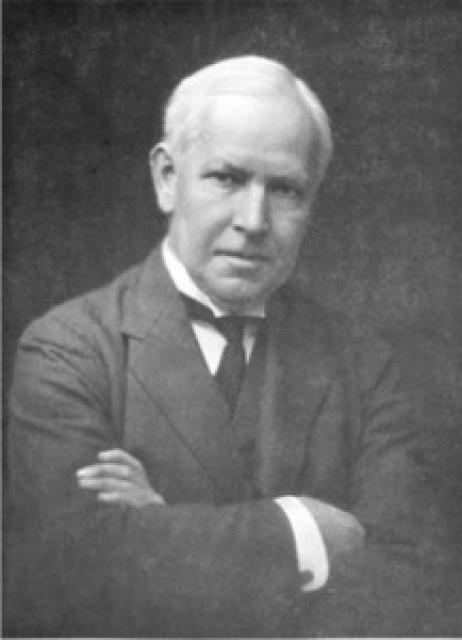
Grafton Elliot Smith
 Great Britain
- Biography of Grafton Elliot Smith
- Contributions to the Study of Brain Evolution
- Personal Life and Legacy
Biography of Grafton Elliot Smith
Grafton Elliot Smith, an English-Australian anthropologist and anatomist, was a proponent of hyperdiffusionism, an extreme form of diffusionism in archaeology. He was born on August 15, 1871, in Grafton, New South Wales, Australia. Smith studied medicine at the University of Sydney, where he obtained his Doctor of Medicine degree in 1895, conducting research on the frontal brain of monotremes for his dissertation. Over time, Smith developed a keen interest in human brain anatomy. He furthered his studies at Cambridge in 1896 while compiling a catalog of human brain data for the British Museum.
From 1900 to 1909, Smith served as the first head of the Department of Anatomy at the Cairo School of Medicine, where he conducted research on the brains of Egyptian mummies. He became the first scientist to take X-ray images of mummies. In 1907, Grafton was selected as a consultant for archaeological excavations in Nubia. From 1909 to 1919, he held the position of Professor of Anatomy at the University of Manchester, and from 1919 to 1937, he was the head of the Department of Anatomy at University College London. Smith served as the President of the Anatomical Society of Great Britain and Ireland from 1924 to 1927. During World War I, he visited hospitals to observe patients with neuroses and was a member of the British General Medical Council.
Contributions to the Study of Brain Evolution
Smith was a leading expert of his time in the field of brain evolution. Many of his ideas on primate brain evolution continue to shape modern theories. Both British anthropologists, Arthur Keith and Grafton Elliot Smith, supported the theory that Europe was the cradle of humanity, rejecting models of Asian and African origins. The arguments in favor of Smith's model later became known as diffusionist theory. According to Smith and William James Perry, Egypt was credited as the foundation of human civilization and all cultural innovations.
According to the popular extreme diffusionist view, which Smith advocated, small groups of people, primarily traveling by sea, settled in specific areas and created crude imitations of monumental Egyptian structures such as pyramids. Smith also believed that agriculture originated in Egypt and later spread to Mesopotamia. He wrote, "In fact, the first agriculturists in Egypt laid the foundations not only for agriculture and irrigation but also for all arts and crafts, social organization, and religious beliefs that have become an integral part of the development of civilization, which was created sixty centuries ago and later spread throughout the world." However, it is now widely accepted that megalithic tombs in Britain, Ireland, France, Portugal, the Netherlands, Denmark, northern Germany, and Poland predate Egyptian pyramids, and the age of Mesoamerican pyramids, likely resulting from local development, is even younger.
Personal Life and Legacy
Grafton Elliot Smith married Kathleen Macredie in 1902. During his time in London, he resided in Hampstead, Gower Street, and Regent's Park. In London, Smith met and became close friends with Dr. William Rivers. Sadly, Smith's youngest son, Stephen, died in an accident in 1936.
In the last year of his life, Smith resided in a nursing home, where he passed away on January 1, 1937.


