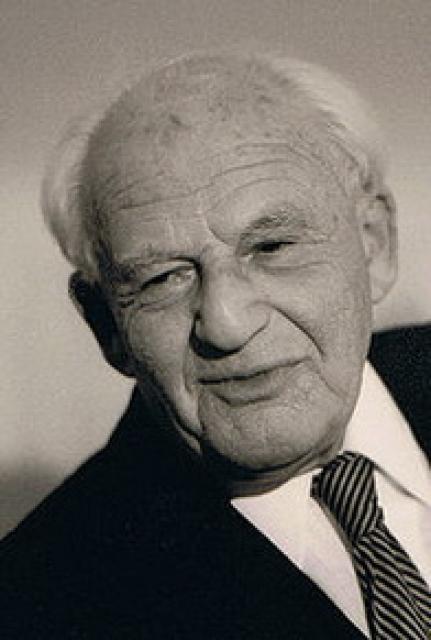
Guido Beck
 Germany
- Early Life and Education
- Soviet Union
- War and Emigration
- Influence in South America
- Later Career and Return to Argentina
- Legacy
Early Life and Education
Guido Beck was born in Reichenberg, Austria-Hungary (now Liberec, Czech Republic). His contributions to physics began with his work on beta decay, which was later superseded by Enrico Fermi's more comprehensive theory.
Soviet Union
In 1935, Beck was invited by Elpidifor Kirillov, director of the Institute of Physics at Odessa University, to work in the Soviet Union. Beck headed the Department of Theoretical Physics and taught in German, with assistant Yu.G. Vekhstein translating simultaneously into Ukrainian. He also led the Department of Theoretical Mechanics at the Institute of Water Transport Engineers in Odessa from 1936 to 1937.
War and Emigration
During World War II, Beck relocated to France, where he was imprisoned after the outbreak of hostilities. He escaped to Portugal in 1941 and emigrated to Argentina in 1943.
Influence in South America
In Argentina, Beck mentored numerous physicists, including José Antonio Balseiro. He left a profound impact on the development of physics in the country. In 1951, he moved to Brazil, where he continued to influence scientific advancements.
Later Career and Return to Argentina
Following Balseiro's death in 1962, Beck was invited back to Argentina and continued his work at the Balseiro Institute. He later returned to Brazil in 1975, working at the Centro Brasileiro de Pesquisas Físicas (CBPF).
Legacy
Guido Beck's legacy extends beyond his contributions to beta-decay theory. He was a renowned educator who inspired generations of South American physicists. He was also a close friend of the renowned writer Ernesto Sabato. Beck died in a car accident in Rio de Janeiro in 1988.


