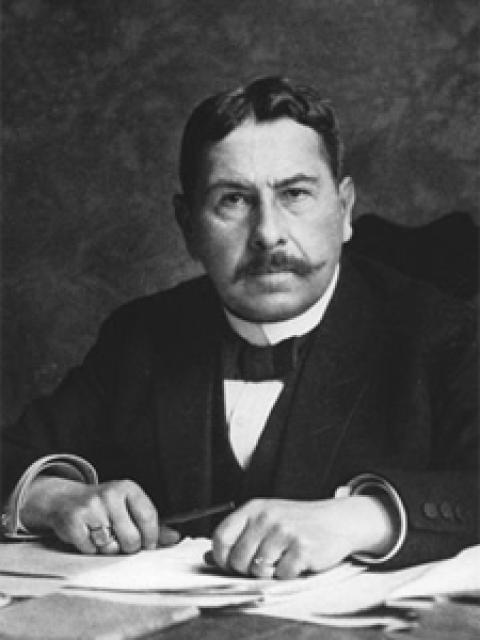
Gustav Kar
 Germany
Biography of Gustav Kahr
Gustav von Kahr (1862-1934) was a political figure in Bavaria. He was born on November 29, 1862 in Weissenburg, Bavaria. From the 1890s, he actively participated in the activities of the local Bavarian government. In 1911, he was conferred with a noble title (Ritter von). From 1917 to 1924, he served as the head of the Bavarian government.
Political Career
After the formation of the Weimar Republic, Kahr, a staunch monarchist, advocated for the autonomy of Bavaria and opposed the central government. In response to separatist sentiments, President Friedrich Ebert declared a state of emergency in the country on September 26, 1923. In retaliation, Kahr declared himself the General Commissioner of Bavaria, which was seen as rebellion by the central government in Berlin.
Various monarchist groups rallied around Kahr's separatist program, led by General Otto von Lossow, the commander of the Reichswehr in Bavaria, and Colonel Hans von Seisser, the head of the Bavarian police. Adolf Hitler, whose influence and popularity were rapidly growing in Bavaria, considered Kahr's separatism a betrayal of national interests and a threat to the unity of the Reich.
The Beer Hall Putsch
Fearing the rise of the competing Nazi Party, Kahr banned NSDAP gatherings in late September 1923. In this situation, Hitler decided to seize the initiative, proclaim a "national revolution," and organize a "march on Berlin." During the Beer Hall Putsch in 1923, Hitler offered Kahr and von Lossow to join the "national revolution" and be part of the new government, holding them hostage temporarily.
Kahr and von Lossow, under their word of honor, immediately began developing a plan to suppress the Nazi uprising. Munich was surrounded by troops, and Kahr issued a decree banning the activities of the NSDAP. The putsch was suppressed, and Hitler stood trial. From 1924 to 1927, Kahr served as the President of the Bavarian Supreme Court.
Assassination
During the events of the "Night of the Long Knives" in 1934, Kahr was killed in his home in Munich by the Nazis, who resented his role in suppressing their rebellion.