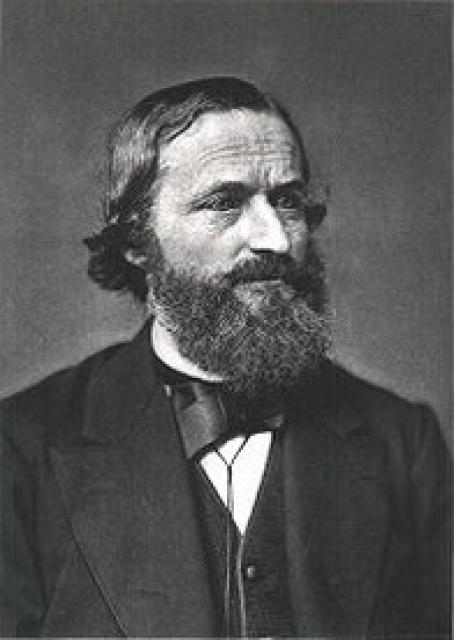
Gustav Kirchhoff
 Germany
- Gustav Robert Kirchhoff: A Renowned Physicist of the 19th Century
- Academic Career
- Contributions to Mathematical Physics and Mechanics
- Revolutionary Advancements in Radiation and Spectral Analysis
- Other Notable Works
Gustav Robert Kirchhoff: A Renowned Physicist of the 19th Century
Gustav Robert Kirchhoff, one of the most eminent physicists of the 19th century, was born on March 12, 1824, in Königsberg.
Academic Career
Kirchhoff began his academic journey at the University of Königsberg in 1842, studying mathematics and physics. In 1847, he became a Privatdozent in Berlin and later an Extraordinary Professor in Breslau from 1850-1854. He held the position of Ordinary Professor in Heidelberg until 1874, before returning to Berlin in 1875. During his illustrious career, Kirchhoff was elected a member of the Berlin Academy in 1875 and the St. Petersburg Academy of Sciences in 1862. He passed away on October 17, 1887, in Berlin.
Contributions to Mathematical Physics and Mechanics
Kirchhoff's mathematical acumen and ability to apply it to complex physics problems were unparalleled. His early work on the distribution of electricity on plates (1845-1847) laid the foundation for numerous subsequent studies. He made significant contributions to electricity, including investigations on current distribution in conductors, capacitor discharge, and submarine cable currents. Notably, his work on current induction (1849) introduced a method for determining electrical resistance in absolute units.
In mechanics, Kirchhoff published notable papers on the deformation, equilibrium, and motion of elastic bodies. His lectures on mechanics, aiming to eliminate the need for concepts of mass and force as causal factors in motion, earned wide acclaim.
Revolutionary Advancements in Radiation and Spectral Analysis
Kirchhoff's seminal research on radiation marked a turning point in physics. His collaborative work with chemist Robert Bunsen (1858-1860) led to the discovery of spectral line reversals, the explanation of Fraunhofer lines, and the establishment of spectral analysis as a fundamental tool in physics, chemistry, and astronomy.
Other Notable Works
Kirchhoff also made significant contributions to thermodynamics, optics, and the study of the effects of magnetic and electric forces on the shape of bodies (1884-1885). His research was primarily published in renowned scientific journals and later compiled in his "Gesammelte Abhandlungen" (1882). Additionally, he authored several volumes of "Vorlesungen über Mathematische Physik" (1876 onwards) and the acclaimed investigation of spectra, "Untersuchungen über das Sonnenspectrum und die Spectren der chemischen Elemente" (1861), which was also translated into English.


